
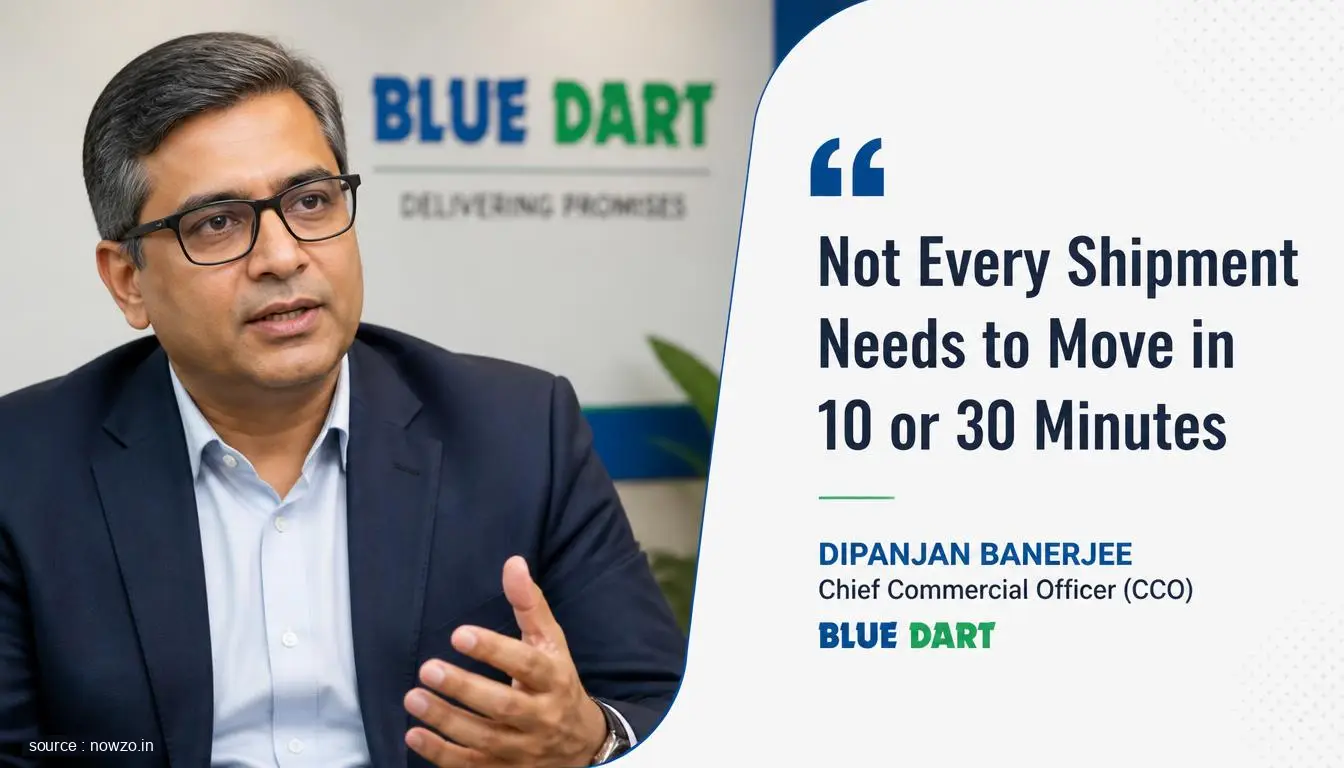
At a time when India's delivery ecosystem is increasingly defined by speed, Blue Dart Chief Commercial Officer Dipanjan Banerjee has offered a measured perspective on the logistics industry's direction. His central argument is straightforward: not every shipment needs to move in 10 or 30 minutes.
The remarks come as quick commerce and hyperlocal delivery platforms continue to reshape consumer expectations across India, pushing businesses to compete on ever-shorter delivery windows. Banerjee's comments, made in an interview with Fortune India, suggest that the logistics sector may benefit from a more nuanced approach to speed and service differentiation.
A Counterpoint to the Quick Commerce Frenzy
India's quick commerce sector has grown rapidly in recent years, with companies promising deliveries in as little as 10 minutes. This model has captured significant consumer attention and investor interest, transforming how groceries, essentials, and other products reach doorsteps in urban areas.
However, Banerjee's perspective challenges the notion that ultra-fast delivery should be the universal standard. As the Chief Commercial Officer of Blue Dart, one of India's leading express logistics companies, his views carry considerable weight in an industry grappling with questions about sustainability, cost structures, and operational efficiency.
The statement that not every shipment needs to move in 10 or 30 minutes reflects a broader debate within the logistics and supply chain sector. While speed is undeniably important for certain categories of goods, many shipments may be better served by reliable, cost-effective delivery models that do not prioritize extreme speed above all else.
Blue Dart's Position in India's Logistics Landscape
Blue Dart has long been a prominent name in India's express delivery and logistics market. The company operates across a wide network, serving businesses and consumers with a range of shipping and supply chain solutions.
As Chief Commercial Officer, Dipanjan Banerjee plays a key role in shaping the company's commercial strategy and its response to shifting market dynamics. His comments to Fortune India provide insight into how established logistics players are thinking about the competitive pressures created by newer, speed-focused delivery models.
The logistics industry in India has undergone significant transformation in recent years, driven by the growth of e-commerce, changing consumer behavior, and technological advancements. Companies across the sector have been forced to adapt, investing in infrastructure, technology, and last-mile delivery capabilities to remain competitive.
The Broader Debate on Delivery Speed
Banerjee's observation touches on a fundamental question facing the logistics industry: how should companies balance speed against other factors such as cost, reliability, and operational sustainability?
The rise of 10-minute and 30-minute delivery models has set new benchmarks for speed, but it has also raised questions about the long-term viability of such approaches. Industry observers have noted that ultra-fast delivery often comes with higher operational costs and logistical complexity.
By asserting that not every shipment requires such rapid movement, Banerjee appears to be advocating for a more segmented approach to logistics — one in which delivery speed is matched to the actual needs of the shipment and the customer, rather than applied uniformly across all categories.
Looking Ahead
As India's logistics and delivery ecosystem continues to evolve, the perspectives of industry leaders like Dipanjan Banerjee will play an important role in shaping the conversation. His comments serve as a reminder that while speed is a powerful differentiator, it is not the only factor that matters in building a sustainable and efficient logistics operation.
For businesses and consumers alike, the question of how fast a shipment truly needs to move is likely to remain a topic of active discussion as the industry matures and new models continue to emerge.

Comments