
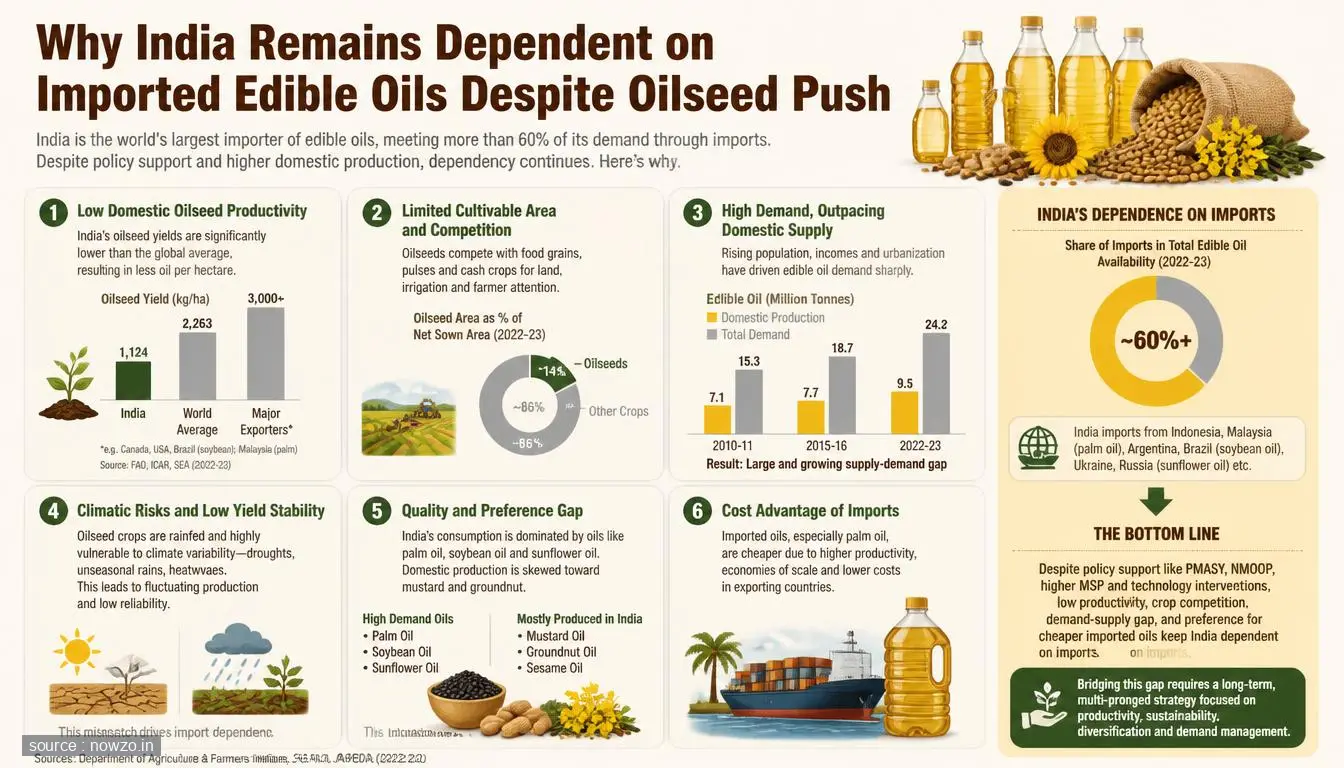
India's reliance on imported edible oils remains a persistent challenge for the country's agricultural economy, even as policymakers push for greater self-sufficiency in oilseed production. The fundamental issue, according to analysis, lies in the economics of oilseed cultivation, which continues to make imports more attractive than domestic production for meeting the country's growing demand.
The Import Dependence Problem
India is one of the world's largest importers of edible oils, sourcing a significant portion of its domestic consumption from international markets. This dependence has persisted despite various government initiatives aimed at boosting local oilseed production and reducing the import bill.
The country's edible oil consumption has grown steadily over the years, driven by population growth, rising incomes, and changing dietary patterns. However, domestic oilseed production has not kept pace with this rising demand, creating a widening gap that is filled through imports.
Economic Factors Behind Low Domestic Production
The economics of oilseed production in India present several challenges that discourage farmers from expanding cultivation. Oilseeds often compete with other crops for land and resources, and in many cases, alternative crops offer better returns or lower risk profiles for farmers.
Several structural factors contribute to the uncompetitive nature of domestic oilseed production:
- Lower yields compared to international standards
- Higher production costs relative to imported alternatives
- Limited access to quality seeds and modern farming techniques
- Inadequate price support mechanisms
- Infrastructure gaps in processing and marketing
These factors combine to make oilseed cultivation less attractive for Indian farmers, who often opt for crops with more predictable returns or better market support.
Government Efforts and Their Limitations
The Indian government has launched various schemes and programs over the years to promote oilseed production and reduce import dependence. These initiatives have included price support mechanisms, subsidies for inputs, and campaigns to encourage oilseed cultivation.
However, these efforts have had limited success in fundamentally altering the economics of oilseed production. The structural challenges facing the sector require more comprehensive solutions that address productivity, cost competitiveness, and market access simultaneously.
The Path Forward
Reducing India's dependence on imported edible oils will require a multi-pronged approach that addresses the underlying economic disincentives for domestic oilseed production. This could include investments in research and development to improve yields, better infrastructure for processing and marketing, and policy frameworks that make oilseed cultivation more remunerative for farmers.
Until these fundamental economic issues are addressed, India's reliance on imported edible oils is likely to continue, with implications for the country's trade balance, food security, and agricultural sector development.


Comments