
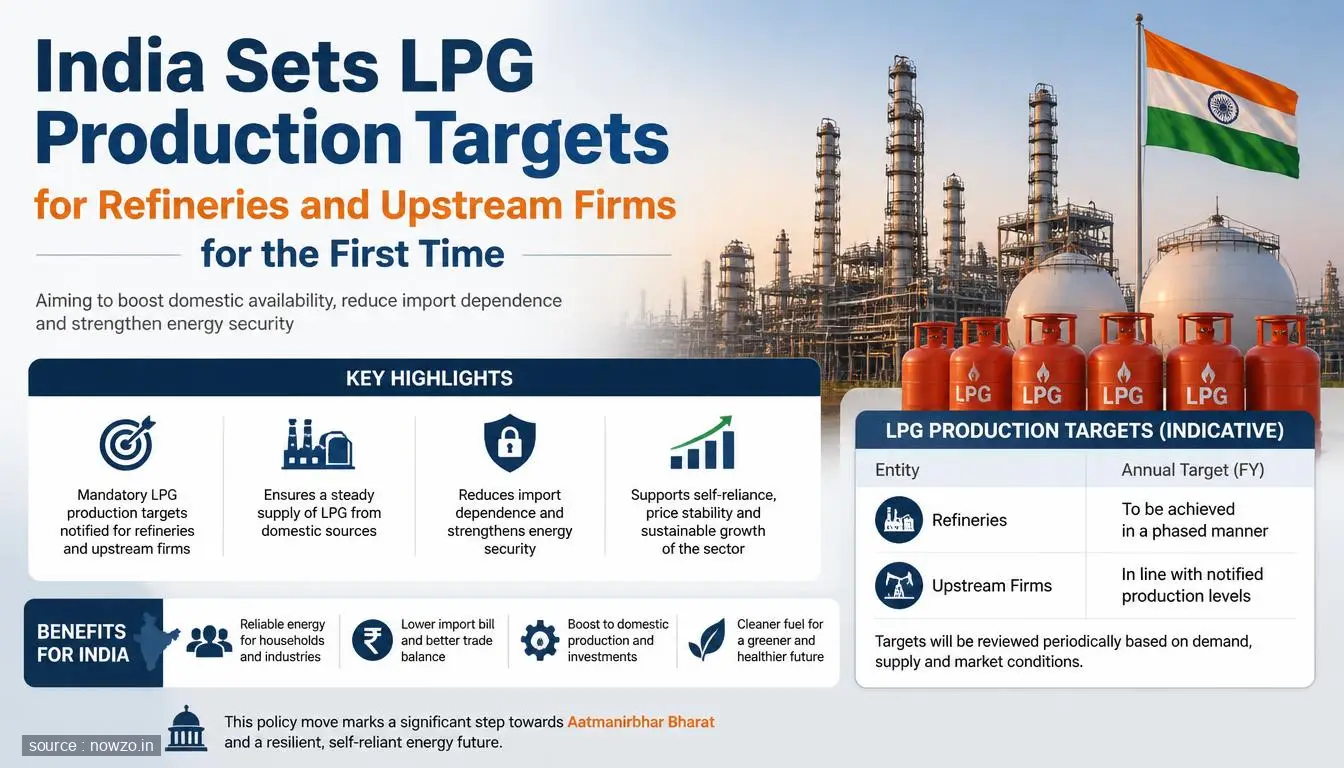
The Indian government has, for the first time, set liquefied petroleum gas (LPG) production targets for refineries and upstream companies, according to a report by Telegraph India. The decision comes at a time when concerns over domestic supply of cooking gas have been growing, with demand continuing to rise across the country.
The move marks a significant shift in how the government approaches LPG production planning. Until now, refineries and upstream firms operated without fixed production targets for LPG. By introducing these targets, the government aims to ensure a more stable and predictable supply of cooking gas for households and businesses.
Why the Government Has Introduced LPG Production Targets
India is one of the largest consumers of LPG in the world, with millions of households relying on it as their primary cooking fuel. Over the years, government schemes such as the Pradhan Mantri Ujjwala Yojana have expanded access to LPG connections, particularly in rural and low-income households. This expansion has led to a steady increase in demand.
Despite being a major consumer, India depends heavily on imports to meet its LPG requirements. A significant portion of the country's cooking gas is sourced from international markets, making domestic supply vulnerable to global price fluctuations and supply chain disruptions. The introduction of production targets is seen as a step toward reducing this dependence and strengthening energy security.
What the Targets Mean for Refineries and Upstream Firms
Refineries and upstream oil and gas companies will now be expected to meet specific LPG production goals set by the government. This is the first time such targets have been formally established for these entities. The targets are expected to push companies to optimize their operations and prioritize LPG output alongside other petroleum products.
Refineries produce LPG as a byproduct during the crude oil refining process, while upstream firms extract it during natural gas and crude oil production. By setting clear targets, the government is signaling that LPG production should be treated as a priority rather than a secondary output.
Supply Concerns and the Broader Energy Landscape
The decision to fix production targets comes amid broader concerns about energy supply and affordability. Global energy markets have experienced volatility in recent years, driven by geopolitical tensions, supply chain challenges, and fluctuating crude oil prices. These factors have had a direct impact on the cost and availability of LPG in India.
For Indian consumers, any disruption in LPG supply or a sharp rise in prices can have a significant impact on household budgets. The government's move to set production targets is aimed at creating a buffer against such disruptions by boosting domestic output.
Looking Ahead
The introduction of LPG production targets is a notable development in India's energy policy. It reflects the government's recognition of the growing importance of cooking gas in the country's energy mix and the need to ensure reliable supply for millions of consumers.
As the targets are implemented, the focus will be on how effectively refineries and upstream firms respond to the new requirements. The success of this initiative will depend on the ability of these companies to ramp up production while maintaining operational efficiency. For now, the move signals a proactive approach by the government to address supply concerns and strengthen India's energy security.




Comments