
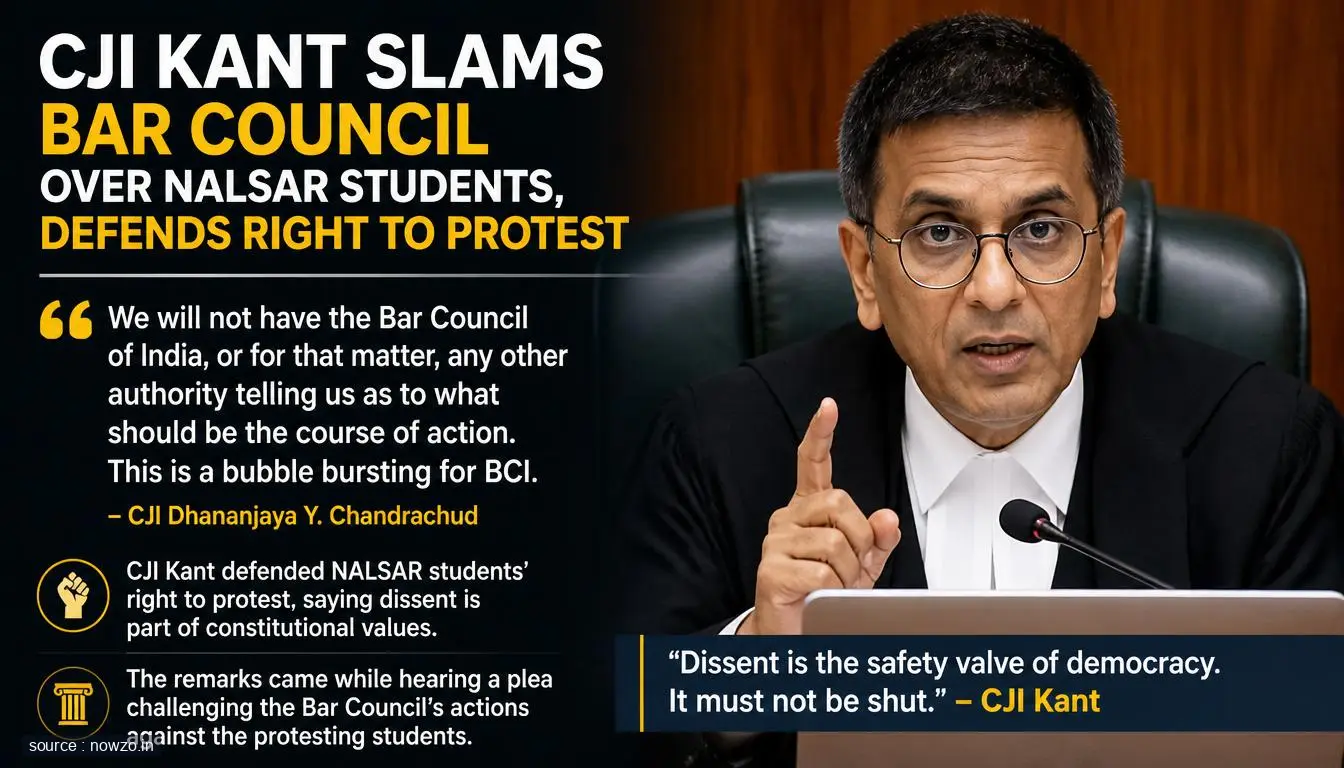
Chief Justice of India Kant has delivered a sharp rebuke to the Bar Council of India (BCI) over its decision to bar students from the National Academy of Legal Studies and Research (NALSAR), questioning the body's authority and defending the students' right to protest.
The CJI's remarks came amid growing controversy surrounding the BCI's action against NALSAR students, which has sparked debate about the limits of regulatory power over legal education institutions and student activism.
"BCI Has No Business"
In his strongly worded comments, CJI Kant did not mince words about the Bar Council of India's involvement in the matter. "BCI has no business, who are they..." the Chief Justice stated, directly challenging the bar body's jurisdiction and its decision to take action against the students.
The Chief Justice's intervention underscores the seriousness with which the judiciary views the BCI's move, particularly when it comes to matters involving students' fundamental rights and freedoms.
Defending Students' Right to Protest
Beyond questioning the BCI's authority, CJI Kant also took a firm stand in defense of the students' right to protest. The Chief Justice's remarks signal judicial support for student activism and the expression of dissent within academic institutions.
The CJI's position aligns with broader constitutional principles that protect the right to peaceful assembly and expression, even within the context of educational institutions.
Implications for Legal Education
The confrontation between the Chief Justice and the Bar Council of India raises important questions about the governance of legal education in India and the balance of power between regulatory bodies and academic institutions.
NALSAR, one of India's premier law schools, has been at the center of this controversy, with its students facing restrictions imposed by the BCI. The CJI's intervention may have significant implications for how such disputes are resolved in the future.
What Comes Next
With the Chief Justice of India now publicly questioning the BCI's actions, the bar body may face pressure to reconsider its position regarding the NALSAR students. The CJI's remarks could also influence ongoing discussions about student rights and academic freedom in legal education institutions across the country.
The development marks a significant moment in the ongoing dialogue about the role of regulatory bodies in educational institutions and the protection of students' constitutional rights.






Comments