
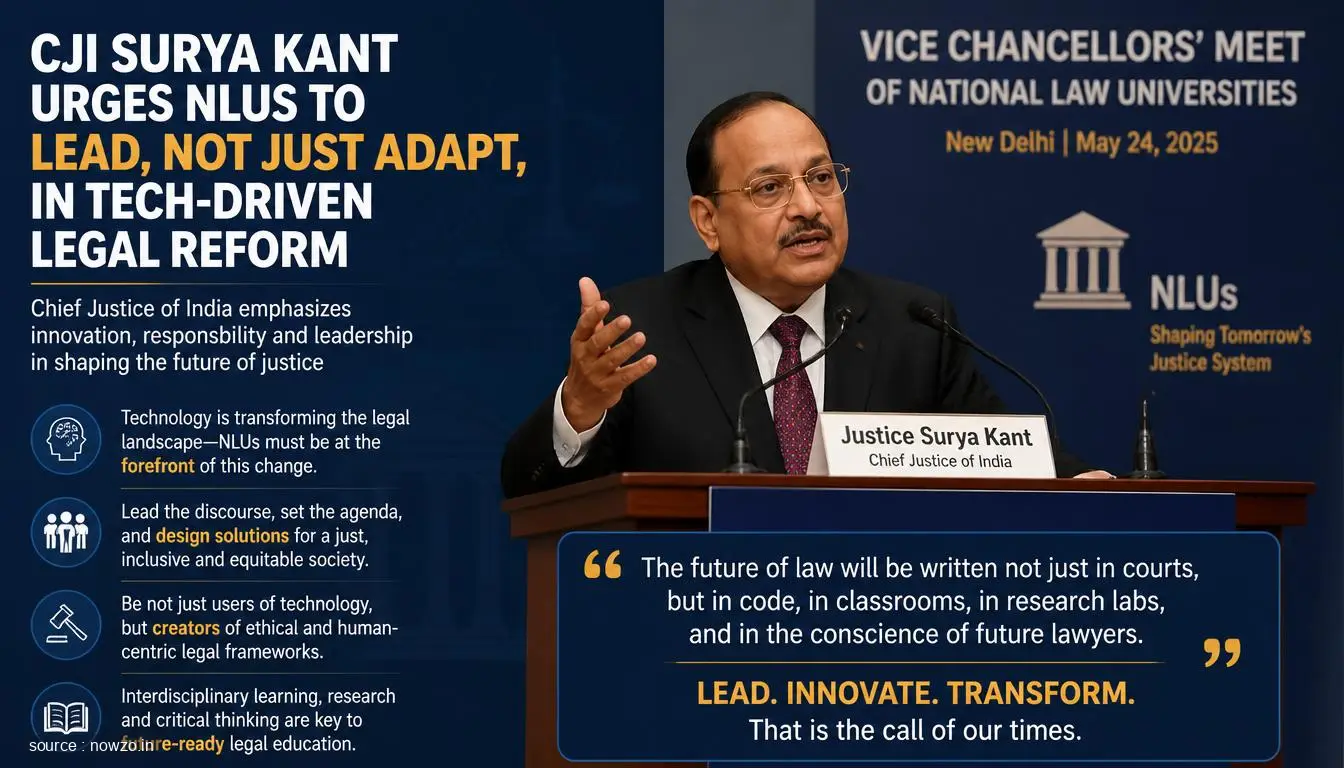
Chief Justice of India Surya Kant has called upon National Law Universities (NLUs) to move beyond simply adapting to technological change and instead take a leading role in determining how technology is used to reshape the legal system.
Speaking to the NLUs, the Chief Justice emphasized that legal institutions must not remain passive recipients of technological transformation. Rather, they should actively shape the direction and manner in which technology influences the practice and administration of law.
Leadership Over Adaptation
The core message from CJI Surya Kant was clear: legal education institutions should not merely respond to technological developments as they arise. Instead, they must position themselves at the forefront of deciding how these tools are integrated into the legal framework.
"Don't just adapt but lead in determining use of technology to reshape legal system," the Chief Justice told the NLUs, underscoring the proactive role he envisions for these premier institutions.
The Role of National Law Universities
National Law Universities occupy a unique position in India's legal education landscape. As centers of excellence, they are expected to produce not only skilled legal professionals but also thought leaders who can influence the future direction of the justice system.
CJI Surya Kant's remarks highlight the expectation that these institutions will engage deeply with emerging technologies and contribute meaningfully to how they are deployed within the legal ecosystem. This includes shaping policies, ethical frameworks, and practical applications that govern technology's role in law.
Technology and the Future of the Legal System
The intersection of technology and law has become an increasingly important area of focus in India. From digitization of court processes to the use of artificial intelligence in legal research, technology is transforming how the legal system operates.
The Chief Justice's call to action suggests that NLUs should be at the vanguard of this transformation, ensuring that technological adoption serves the broader goals of justice, accessibility, and efficiency. By leading rather than following, these institutions can help ensure that the integration of technology into the legal system is thoughtful, deliberate, and aligned with constitutional values.
A Vision for Legal Education
CJI Surya Kant's address reflects a broader vision for legal education in India — one where institutions are not just training grounds for lawyers but active participants in shaping the future of the justice delivery system. His emphasis on leadership signals a shift in expectations for how law schools engage with the rapidly evolving technological landscape.
As technology continues to advance, the role of legal institutions in guiding its application will only grow in importance. The Chief Justice's message serves as both a challenge and an invitation for NLUs to rise to the occasion and define the future of law in the digital age.






Comments