
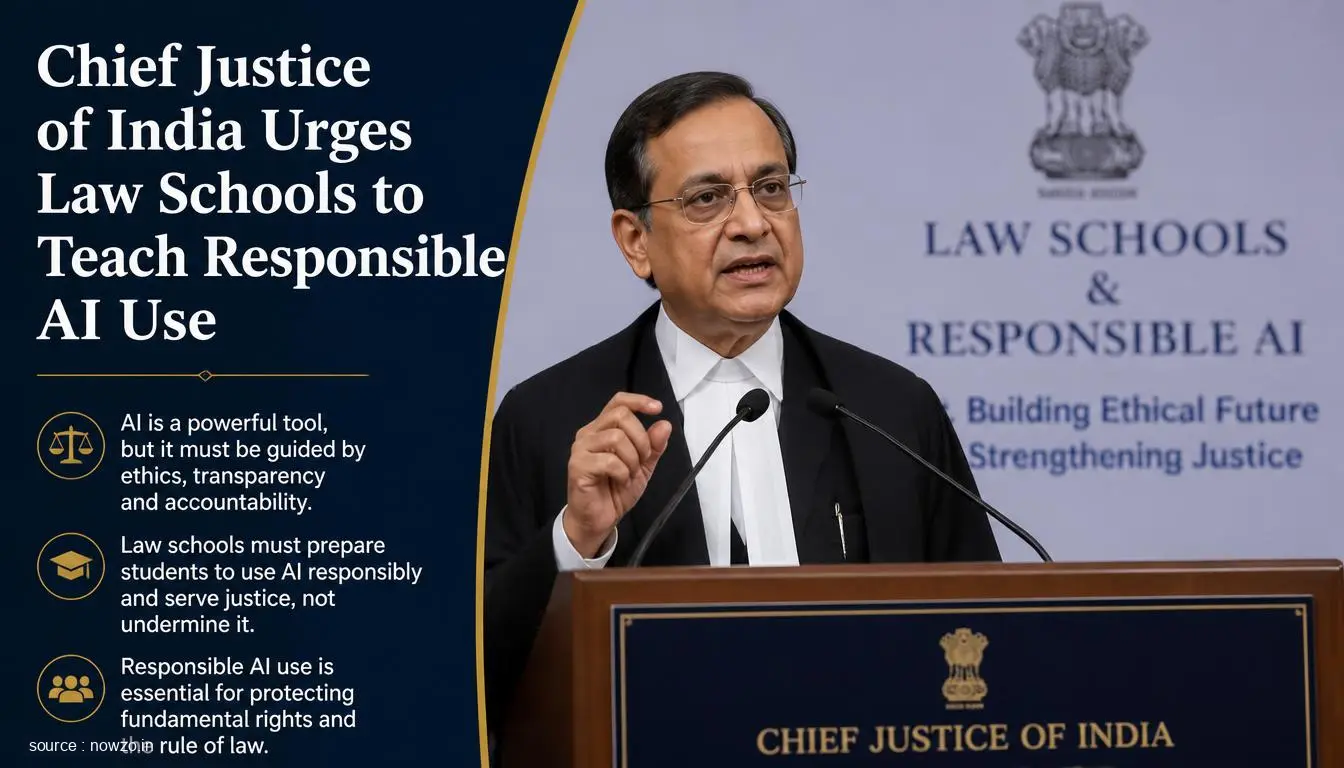
The Chief Justice of India has called upon law schools to take an active role in preparing students for a legal landscape increasingly shaped by artificial intelligence. Speaking on the intersection of technology and legal education, the CJI emphasized that future lawyers must be trained to use AI tools responsibly, ensuring that technological advancement goes hand in hand with ethical awareness and professional integrity.
AI's Growing Presence in the Legal Profession
Artificial intelligence is rapidly transforming industries across the globe, and the legal sector is no exception. From legal research and document review to contract analysis and case prediction, AI-powered tools are becoming integral to the day-to-day work of legal professionals. As these technologies continue to evolve, the demand for lawyers who understand both the capabilities and limitations of AI is growing steadily.
The CJI's remarks underscore a recognition at the highest level of the Indian judiciary that legal education must adapt to keep pace with these changes. Rather than viewing AI as a distant or abstract concept, the message from the Chief Justice is clear: law schools have a responsibility to equip their students with the knowledge and skills needed to navigate an AI-driven professional environment.
The Call for Responsible AI Training in Legal Education
Central to the CJI's message is the emphasis on responsibility. While AI tools offer significant benefits in terms of efficiency, accuracy, and access to information, they also raise important questions about bias, accountability, transparency, and the ethical boundaries of machine-assisted decision-making. The Chief Justice's appeal to law schools is not simply about familiarizing students with new technology — it is about instilling a framework of responsible use that will guide the next generation of legal practitioners.
By urging law schools to integrate responsible AI training into their curricula, the CJI is highlighting the need for a balanced approach. Students must learn not only how to leverage AI tools effectively but also when to exercise caution, how to critically evaluate AI-generated outputs, and how to uphold the ethical standards that underpin the legal profession.
Implications for the Future of Legal Practice in India
The Chief Justice's statement carries significant weight for legal education institutions across India. As one of the most senior figures in the country's judicial system, the CJI's perspective signals that the integration of AI into legal practice is not a matter of if, but when — and that the preparation for this shift must begin in the classroom.
For law schools, this call to action presents both a challenge and an opportunity. Institutions that proactively incorporate AI literacy and ethics into their programs will be better positioned to produce graduates who are not only competent in traditional legal skills but also adept at working alongside emerging technologies. This forward-looking approach could help bridge the gap between academic training and the practical demands of modern legal practice.
As artificial intelligence continues to reshape the professional landscape, the CJI's message serves as a timely reminder that education must evolve in tandem with technology. By training students to use AI tools responsibly, law schools can play a pivotal role in ensuring that the legal profession remains both innovative and grounded in its core values of justice, fairness, and ethical conduct.






Comments