
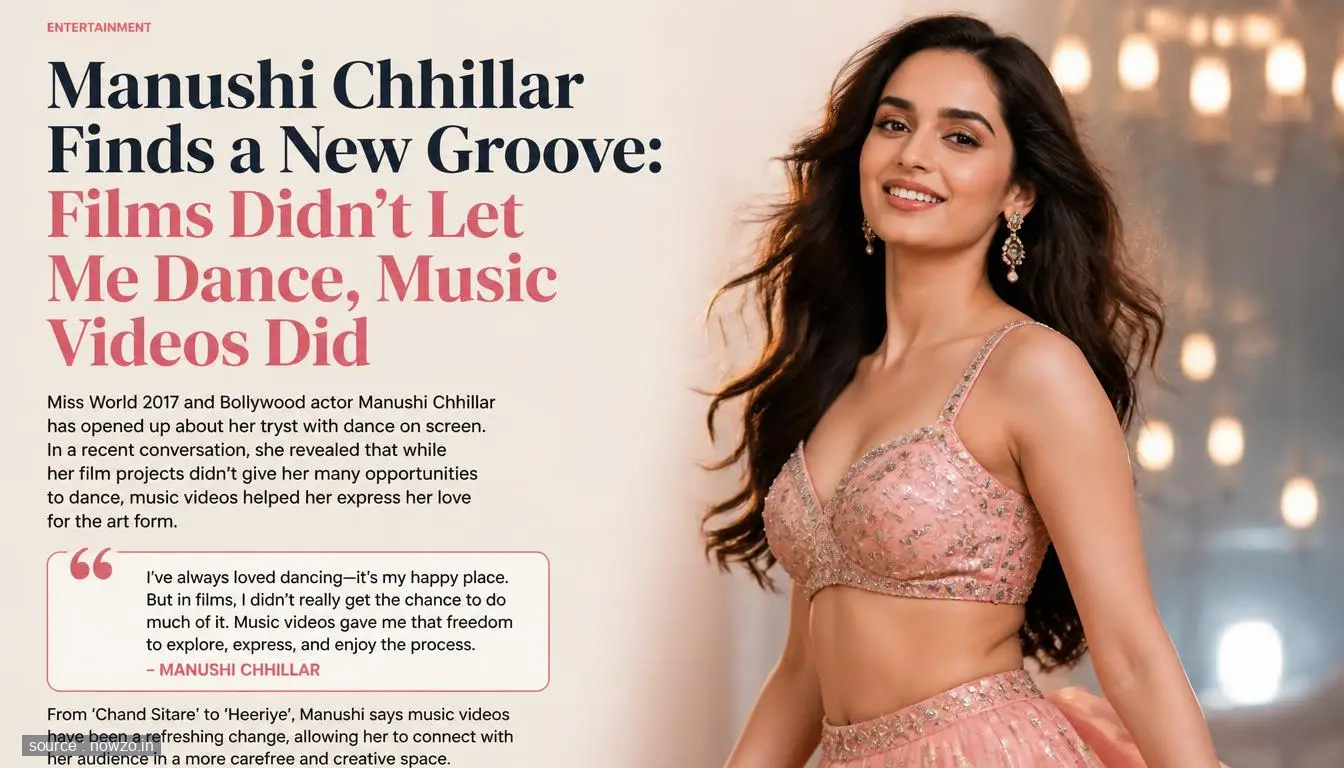
Manushi Chhillar has opened up about a side of her artistic journey that many fans may not have fully seen before. In an exclusive conversation, the actress shared that while films gave her a platform as a performer, they did not always allow her the space to truly dance. Music videos, she said, changed that experience for her and helped her discover a fresh rhythm in her career.
The former Miss World, who has steadily built her presence in the entertainment industry, reflected on how different formats offer different kinds of creative freedom. For Chhillar, the contrast between acting in films and performing in music videos has been especially striking. She made it clear that dance, as a form of expression, found more room to breathe in the music video space.
Manushi Chhillar on discovering a new groove
Chhillar’s remark, “Films didn’t let me dance, music videos did,” captures the heart of her recent reflection. It points to a larger truth about how performers often navigate multiple corners of the entertainment business before finding the medium that best fits a particular part of their talent.
For the actress, music videos appear to have offered a more direct connection to movement, rhythm, and performance. While films often demand that dance fit within a larger narrative structure, music videos can place the physical expression of a performer at the center of the frame. That difference seems to have made a strong impression on her.
Her comments also suggest a sense of creative discovery. Rather than treating one format as a replacement for the other, Chhillar’s perspective highlights how each medium can unlock a different aspect of an artist’s personality. In her case, music videos gave her the chance to embrace dance in a way films had not.
Films versus music videos: a different kind of performance space
In mainstream cinema, dance is often woven into storytelling, character arcs, and spectacle. That can be exciting, but it can also mean that a performer’s movement is shaped by the needs of the script and the larger production. Chhillar’s observation points to that reality without diminishing her film work.
Music videos, by contrast, often allow performers to communicate emotion and energy more immediately. The format is shorter, more stylized, and frequently built around mood and visual impact. For someone like Chhillar, that appears to have created room for a more uninhibited performance style.
This distinction matters because it shows how artists continue to evolve. A performer may be known for one kind of role or public image, but a different format can reveal another dimension altogether. Chhillar’s experience reflects that kind of artistic expansion.
A fresh chapter in Manushi Chhillar’s journey
Chhillar’s statement is likely to resonate with fans who have followed her transition from pageantry to acting and now into a broader entertainment space. It also underlines how important creative fit can be for performers who want to explore more than one lane in the industry.
Her words carry a tone of honesty rather than criticism. She does not dismiss films; instead, she points out that music videos gave her something films did not. That distinction makes her reflection feel grounded and personal, offering insight into how she views her own growth.
As she continues to shape her career, Chhillar’s comments suggest that she is paying close attention to the kinds of projects that allow her to express herself most fully. For audiences, that could mean seeing more of her in spaces where dance and performance take center stage.
Why her comments stand out
What makes Chhillar’s statement especially notable is its simplicity. In one line, she sums up a creative truth that many performers may recognize: not every platform offers the same kind of freedom. Sometimes, it takes a different format to bring out a side of an artist that was always there but waiting for the right outlet.
That idea gives her interview a wider appeal beyond celebrity news. It speaks to anyone who has ever found that one environment, medium, or opportunity allowed them to express themselves more naturally than another. In Chhillar’s case, that outlet appears to be music videos.
For now, her message is clear: films may have introduced her to audiences in one way, but music videos helped her move in another. And in that shift, Manushi Chhillar seems to have found a groove that feels entirely her own.


Comments