
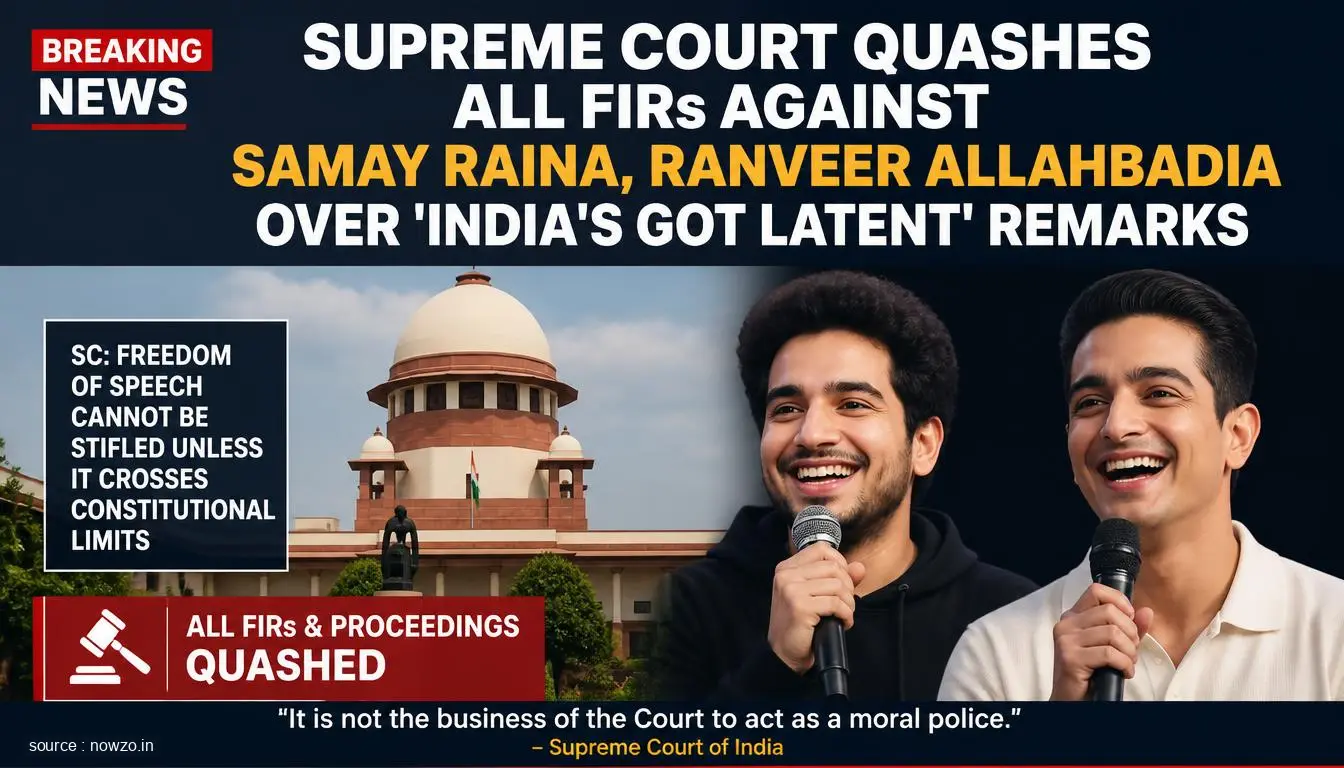
In a significant legal development, the Supreme Court of India has quashed all First Information Reports (FIRs) filed against comedian Samay Raina and popular YouTuber Ranveer Allahbadia, also known as BeerBiceps, in connection with their controversial remarks made on the comedy show 'India's Got Latent'. The ruling brings substantial relief to both content creators, who had been facing multiple criminal complaints across different states following the broadcast of the episode.
Supreme Court Delivers Major Relief to Samay Raina and Ranveer Allahbadia
The apex court's decision to quash all FIRs marks a decisive turn in a case that had drawn widespread national attention. Both Samay Raina and Ranveer Allahbadia had been at the centre of a legal storm after comments made during an episode of 'India's Got Latent' triggered outrage and led to the filing of multiple criminal complaints in various parts of the country.
The Supreme Court's intervention effectively brings an end to the criminal proceedings that had been initiated against the two creators. The ruling is being seen as a landmark moment in the ongoing debate around freedom of expression, digital content creation, and the limits of legal action against comedians and online personalities in India.
Background of the Controversy Surrounding 'India's Got Latent'
The controversy erupted after an episode of 'India's Got Latent', a comedy talent show hosted by Samay Raina, featured remarks that were deemed offensive by several complainants. Ranveer Allahbadia, who appeared as a guest on the show, made comments that quickly went viral on social media and drew sharp criticism from various quarters.
Following the backlash, multiple FIRs were registered against both Raina and Allahbadia in different states. The complaints alleged that the remarks made on the show were inappropriate and offensive, prompting law enforcement agencies in several jurisdictions to initiate criminal proceedings against the two creators.
The case quickly escalated into a national conversation about the boundaries of comedy, the responsibilities of digital content creators, and the role of law enforcement in regulating online speech. Many in the creative community expressed concern over what they described as the chilling effect of multiple FIRs being filed across different states for the same set of remarks.
What the Supreme Court Ruling Means for Content Creators
The Supreme Court's decision to quash all FIRs against Samay Raina and Ranveer Allahbadia is expected to have far-reaching implications for India's rapidly growing digital content ecosystem. The ruling underscores the judiciary's role in protecting creative expression while also addressing concerns about the misuse of criminal complaints to target individuals for their speech.
Legal experts have noted that the practice of filing multiple FIRs in different states for the same alleged offence has long been a contentious issue in India. The Supreme Court's decision to quash all such complaints in this case sends a strong signal about the need to prevent the abuse of legal processes.
For content creators, comedians, and digital influencers, the ruling offers a measure of reassurance that the courts are willing to step in when criminal law is used in a manner that could stifle legitimate creative expression. At the same time, the case has also highlighted the importance of responsible content creation and the need for creators to be mindful of the impact their words can have on diverse audiences.
Reactions and the Road Ahead
The ruling has been welcomed by many in India's comedy and digital content community, who had rallied behind Samay Raina and Ranveer Allahbadia during the legal proceedings. The case had become a rallying point for discussions about artistic freedom and the challenges faced by creators in an increasingly polarised media landscape.
While the Supreme Court's decision brings closure to the criminal proceedings against the two creators, the broader conversation about the regulation of online content and the balance between free speech and accountability is likely to continue. The case has underscored the need for clearer guidelines and legal frameworks to address disputes arising from digital content in India.
As the dust settles on this high-profile legal battle, both Samay Raina and Ranveer Allahbadia can now move forward without the shadow of criminal proceedings hanging over them. The ruling stands as a significant moment in India's evolving legal landscape around digital media and creative expression.


Comments