
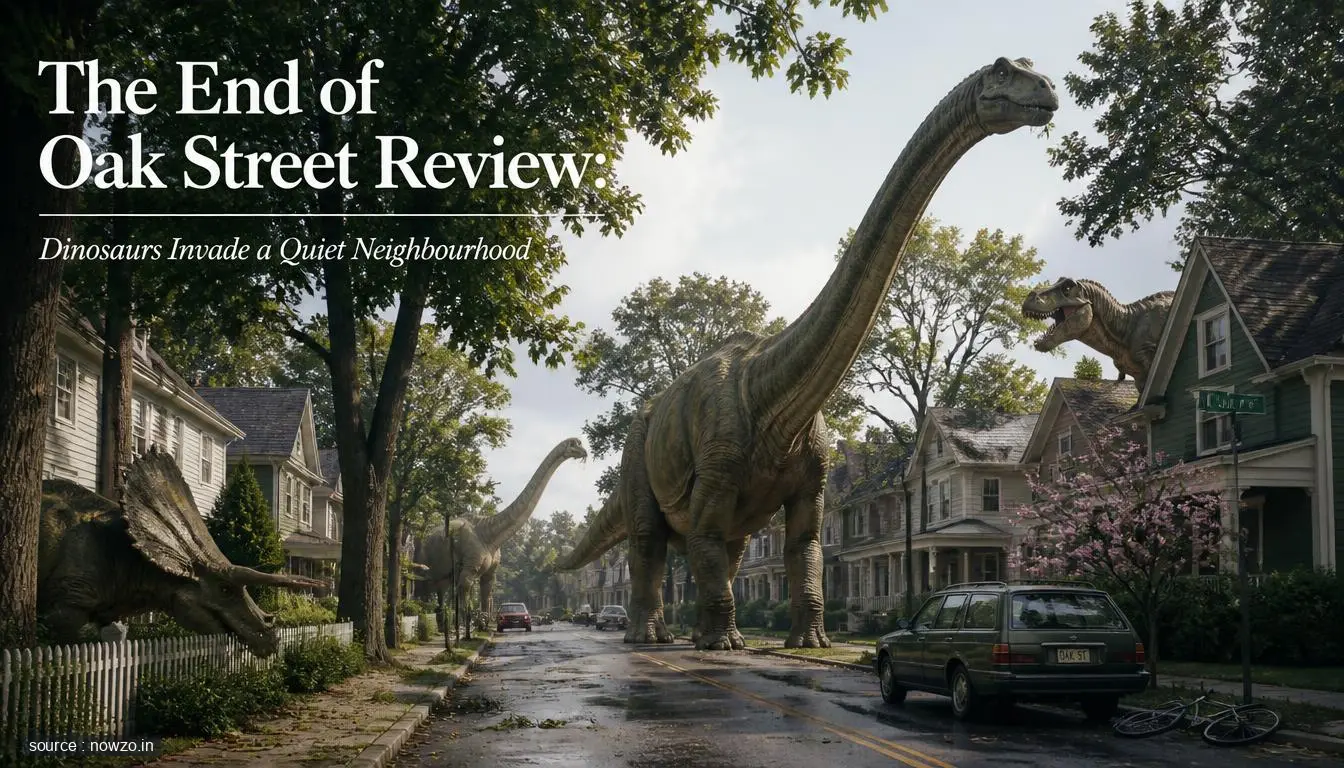
What would happen if dinosaurs entered our neighbourhood? That is the offbeat question at the heart of The End of Oak Street, a film that takes one of cinema's most familiar creatures and drops it into the most ordinary of settings — a quiet suburban street.
A Prehistoric Twist on Everyday Life
Rather than sending its characters to a remote island or a distant jungle, The End of Oak Street flips the classic dinosaur formula on its head. The film imagines a scenario in which these towering prehistoric creatures turn up in a place that looks a lot like home, forcing an ordinary community to confront something wildly out of the ordinary.
The premise leans into the contrast between the mundane and the monstrous. Oak Street is the kind of neighbourhood where daily routines dominate — until the arrival of dinosaurs turns that calm upside down. The film uses this collision of worlds to explore how regular people might react when the impossible shows up on their doorstep.
What the Film Sets Out to Do
At its core, The End of Oak Street is built around a single, playful thought experiment. Instead of treating dinosaurs as distant spectacle, the story brings them into a relatable, lived-in environment. That choice gives the film a distinctive flavour, separating it from the long line of dinosaur adventures that rely on exotic locations and high-concept science.
The neighbourhood setting does much of the heavy lifting. By grounding the action in a familiar street, the film invites audiences to picture themselves in the same situation — looking out the window to find something enormous and ancient wandering past the front lawn.
Verdict
The End of Oak Street stands out for its central conceit alone: a dinosaur story told not on the edges of civilisation, but right in the middle of it. For viewers curious about a fresh spin on a well-worn genre, the film's neighbourhood-invasion premise offers an intriguing hook.
It is a reminder that sometimes the most effective way to make the extraordinary feel real is to place it somewhere utterly ordinary — like the end of a quiet street called Oak.


Comments