
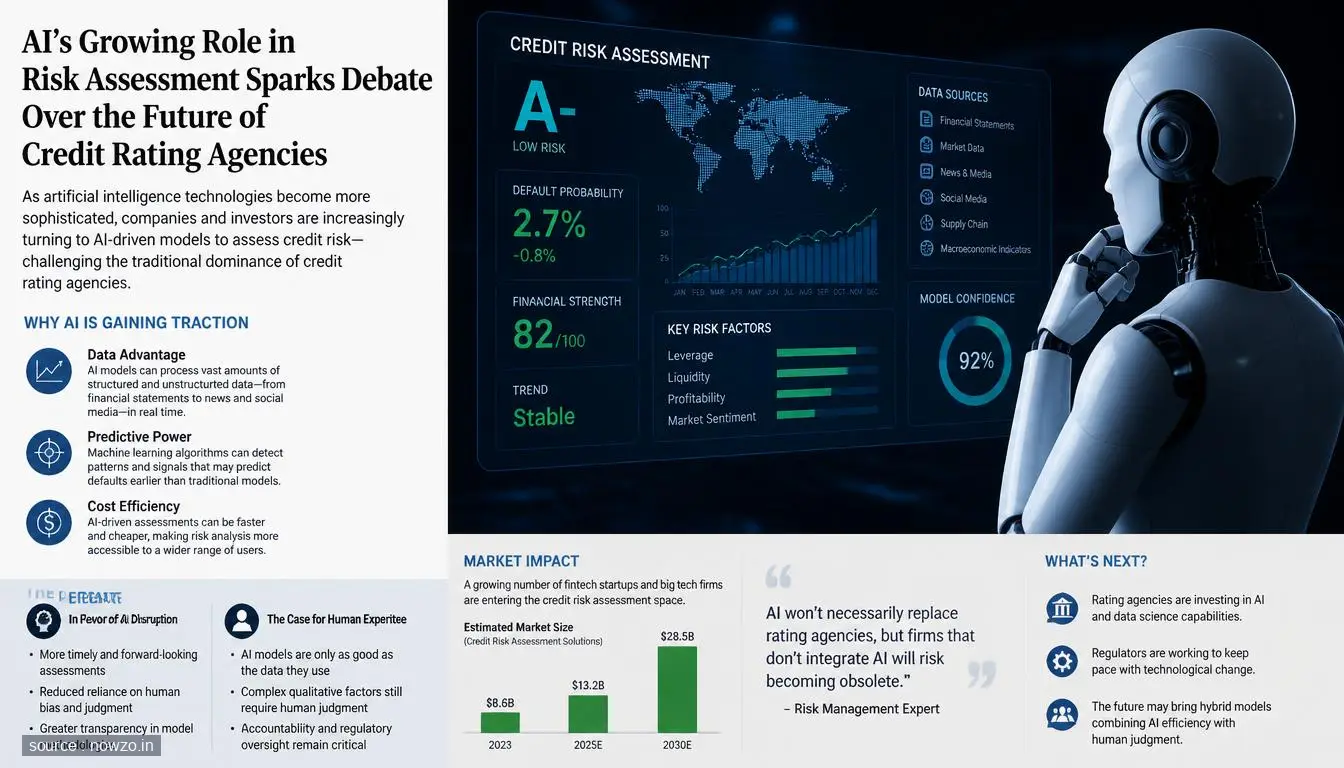
The financial services industry is confronting a provocative question that strikes at the heart of one of its most established institutions: if artificial intelligence can predict risk with greater accuracy and efficiency, what role remains for traditional credit rating agencies?
This emerging debate reflects the broader transformation sweeping through global finance, where machine learning algorithms and advanced data analytics are increasingly challenging long-standing business models and professional practices that have defined the industry for generations.
The Traditional Role of Rating Agencies
Credit rating agencies have long served as gatekeepers of financial markets, providing standardized assessments of creditworthiness for corporations, governments, and financial instruments. Their ratings influence borrowing costs, investment decisions, and regulatory requirements across the global economy.
These agencies built their reputations on proprietary methodologies, analytical expertise, and decades of historical data. Their assessments have become deeply embedded in financial regulations, investment mandates, and institutional decision-making processes worldwide.
However, the traditional rating model has faced criticism over the years, particularly following major financial crises where rating agencies failed to adequately identify systemic risks or were slow to adjust their assessments in response to rapidly changing market conditions.
How AI Is Changing Risk Assessment
Artificial intelligence and machine learning technologies are introducing new capabilities in risk prediction that differ fundamentally from traditional analytical approaches. These systems can process vast quantities of structured and unstructured data at speeds impossible for human analysts.
AI-powered risk assessment tools can analyze alternative data sources, identify subtle patterns and correlations, and continuously update their predictions in real-time as new information becomes available. This dynamic approach contrasts with the periodic review cycles typical of traditional rating methodologies.
Machine learning models can incorporate diverse data points ranging from traditional financial metrics to unconventional indicators, potentially offering more nuanced and timely risk assessments. The technology promises greater objectivity by reducing human biases that may influence conventional rating decisions.
Implications for the Financial Industry
The potential displacement or transformation of credit rating agencies carries significant implications for financial markets, regulatory frameworks, and institutional investors. Rating agencies currently occupy a quasi-regulatory position, with their assessments embedded in countless financial contracts and regulatory requirements.
If AI systems can deliver superior risk predictions, market participants may increasingly rely on algorithmic assessments rather than traditional ratings. This shift could democratize access to sophisticated risk analysis, potentially reducing costs and increasing transparency in credit markets.
However, the transition raises important questions about accountability, transparency, and systemic risk. AI models can be opaque in their decision-making processes, creating challenges for regulatory oversight and market confidence. The concentration of risk assessment in algorithmic systems could also introduce new forms of systemic vulnerability.
The Road Ahead
The question of whether AI will render rating agencies obsolete remains open. Rather than complete displacement, the industry may witness a transformation where traditional agencies adapt by incorporating AI technologies into their own methodologies, or where hybrid models emerge combining human judgment with algorithmic analysis.
Regulatory frameworks will likely need to evolve to address the unique characteristics of AI-driven risk assessment, including issues of model validation, explainability, and accountability. The financial industry's experience with previous technological disruptions suggests that institutional change often occurs gradually, even when underlying technologies advance rapidly.
As artificial intelligence continues to mature and demonstrate its capabilities in financial risk prediction, the debate over the future of credit rating agencies will intensify. The outcome will shape not only the competitive landscape of financial services but also the fundamental mechanisms through which markets assess and price risk.
Comments