
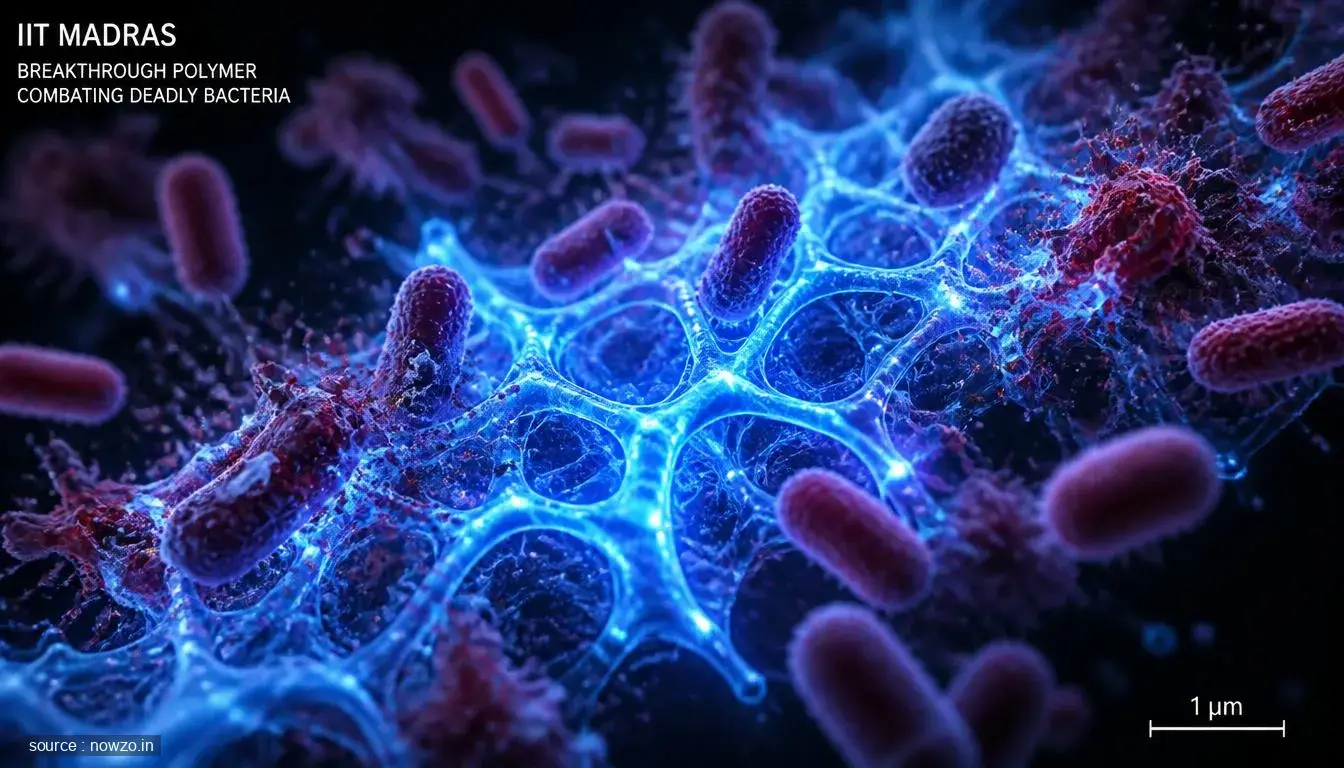
In a significant stride against antimicrobial resistance, researchers at the Indian Institute of Technology Madras have patented a groundbreaking polymer technology capable of destroying harmful bacteria. This innovation arrives at a critical time, as superbugs increasingly defy conventional treatments.
Key facts
- IIT Madras has secured a patent for a new polymer technology.
- The technology is designed to target and eliminate harmful bacteria.
- It addresses the global challenge of antibiotic resistance.
A Response to a Growing Crisis
Antibiotic resistance has escalated into a silent pandemic, claiming millions of lives worldwide. Hospitals grapple with infections that once seemed manageable, now turning lethal. The team at IIT Madras recognized this urgency, channeling their expertise into materials science for a solution that bypasses traditional antibiotics.
How the Technology Works
The patented polymer operates through a mechanical action, physically disrupting bacterial cells upon contact. Unlike drugs that bacteria can evolve to resist, this approach leaves pathogens with no evolutionary escape route. It’s a clever, almost elegant workaround to a problem that has long plagued modern medicine.
Implications and Next Steps
While still in early stages, the technology holds promise for various applications—from medical devices and wound dressings to sanitary surfaces in public spaces. The research team is now focused on scaling production and initiating clinical trials to validate efficacy and safety in real-world settings.


Comments