
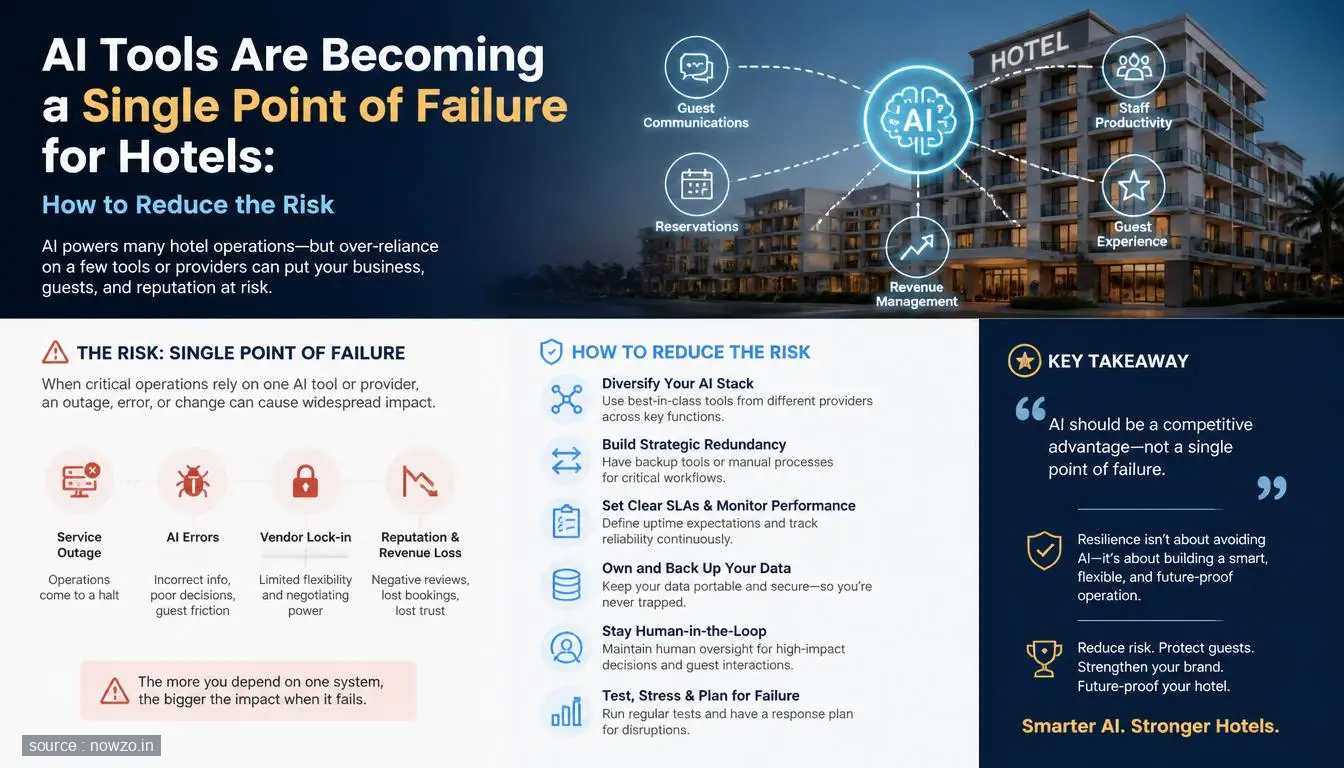
Artificial intelligence has quickly moved from a novelty to a necessity in the hospitality industry. From dynamic pricing engines to AI-powered chatbots handling guest inquiries, hotels are leaning heavily on automated tools to run their day-to-day operations. But that growing dependence comes with a serious downside: AI tools are becoming a single point of failure for hotels, and the consequences of an outage, error, or system breakdown could be severe.
The warning, highlighted in a recent analysis published by PhocusWire, underscores a tension many hoteliers now face. AI promises efficiency, cost savings, and better guest experiences — yet concentrating too many critical functions in a handful of AI systems leaves businesses exposed when those systems fail.
How AI Became Central to Hotel Operations
Over the past few years, hotels have adopted artificial intelligence across nearly every department. Revenue managers rely on AI-driven pricing tools that adjust room rates in real time based on demand signals. Marketing teams use generative AI to produce content and personalize offers. Front desks deploy chatbots and virtual concierges to answer guest questions around the clock, while back-office systems use machine learning to forecast occupancy and manage staffing.
This rapid adoption has delivered real benefits. Automation reduces labor costs, speeds up response times, and allows smaller teams to manage complex operations. However, it also means that a growing share of mission-critical decisions — what price to charge, how to respond to a guest, how to allocate inventory — now flows through AI systems.
The Single Point of Failure Problem
The core concern is concentration risk. When a hotel routes its pricing, guest communication, bookings, and operational decisions through one or two AI platforms, any disruption to those platforms can cascade across the entire business. A technical outage, a flawed model update, a cybersecurity breach, or even a vendor going out of business could bring essential functions to a halt.
Unlike traditional software failures, AI failures can be harder to detect. A pricing algorithm that quietly malfunctions might set rates far too low or too high for hours before anyone notices. A chatbot that begins giving incorrect information can damage guest trust at scale. Because these systems operate autonomously, errors can compound quickly without human oversight.
The risk is amplified by the fact that many hotels depend on the same small group of third-party AI vendors. If a widely used platform experiences downtime, the impact is not limited to a single property — it can affect hundreds or thousands of hotels simultaneously.
How Hotels Can Reduce the Risk
Industry experts recommend several practical steps to avoid over-reliance on any single AI tool:
- Diversify vendors and systems. Avoid routing every critical function through one platform. Using multiple providers for pricing, guest messaging, and operations reduces the chance that one failure cripples the business.
- Maintain human oversight. AI should support decision-making, not replace it entirely. Staff should regularly review automated outputs — especially pricing and guest communications — to catch errors early.
- Build manual fallback procedures. Hotels need documented processes for operating without AI tools, including the ability to set rates manually, respond to guests directly, and manage bookings if systems go down.
- Test contingency plans. Regular drills and simulations help teams practice responding to AI outages before a real incident occurs.
- Scrutinize vendor reliability. Before adopting an AI platform, hotels should evaluate the provider's uptime record, security practices, financial stability, and support responsiveness.
- Retain institutional knowledge. As automation takes over routine tasks, hotels must ensure employees still understand the underlying processes well enough to step in when needed.
Balancing Innovation With Resilience
None of this means hotels should abandon AI. The technology offers genuine competitive advantages, and properties that refuse to adopt it risk falling behind rivals that deliver faster, more personalized service. The goal is not to reject automation but to implement it thoughtfully.
Resilient hotels treat AI as one layer of their operations rather than the foundation. They invest in staff training alongside new tools, keep manual capabilities alive, and design systems with redundancy in mind. In doing so, they capture the benefits of artificial intelligence without betting the entire business on its uninterrupted performance.
The Road Ahead for Hospitality AI
As AI capabilities continue to expand, the temptation to automate even more hotel functions will only grow. Guest expectations for instant, personalized service are rising, and AI is often the most cost-effective way to meet them. But the industry's experience with concentrated technology risk — from central reservation system outages to payment processor failures — offers a clear lesson: convenience today can become vulnerability tomorrow.
For hoteliers, the message is straightforward. Embrace AI, but do so with eyes open. Diversify systems, keep humans in the loop, and prepare for the day when the tools fail — because eventually, every system does. The hotels that plan for that reality will be the ones still standing when it arrives.


Comments