
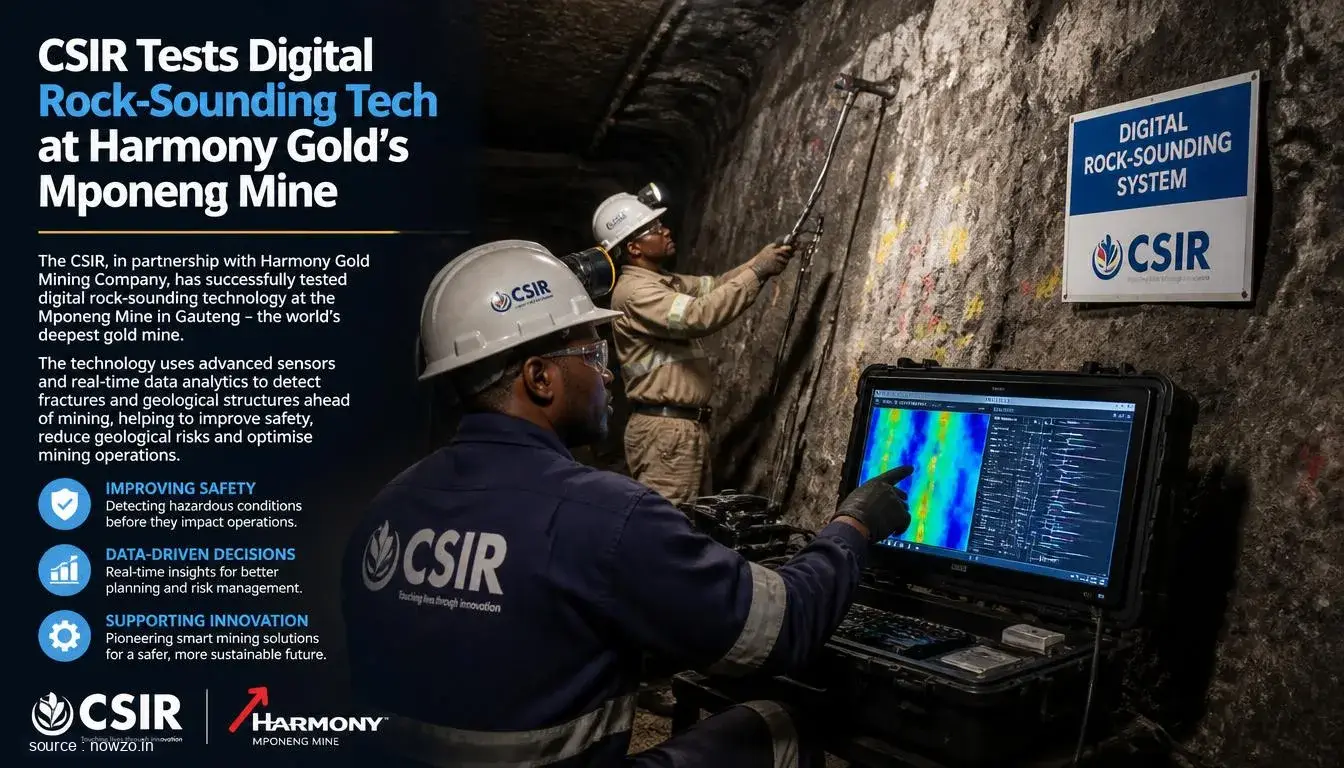
Deep beneath the earth’s surface, where every creak and groan of rock could signal danger, a new digital ear is listening. The Council for Scientific and Industrial Research (CSIR) is testing its groundbreaking digital rock-sounding technology at Harmony Gold’s Mponeng Mine—one of the world’s deepest gold mines.
Key facts
- Technology tested: Digital rock-sounding
- Location: Harmony Gold’s Mponeng Mine
- Developer: Council for Scientific and Industrial Research (CSIR)
Why this matters
In deep-level mining, understanding rock stability isn’t just about efficiency—it’s about lives. Traditional methods rely heavily on human interpretation, but this digital approach promises sharper, faster insights into geological conditions. If successful, it could mean fewer accidents and smarter, safer mining operations.
The technology in action
The system uses advanced sensors and algorithms to analyze acoustic signals from surrounding rock formations. It’s designed to detect subtle shifts and stresses that might escape the human ear, providing real-time data that helps predict potential rockfalls or collapses.
Looking ahead
While still in the testing phase, the technology has generated cautious optimism. Mines like Mponeng operate under extreme pressure, literally and figuratively. Any tool that enhances safety without sacrificing productivity could be a game-changer for the industry.


Comments