
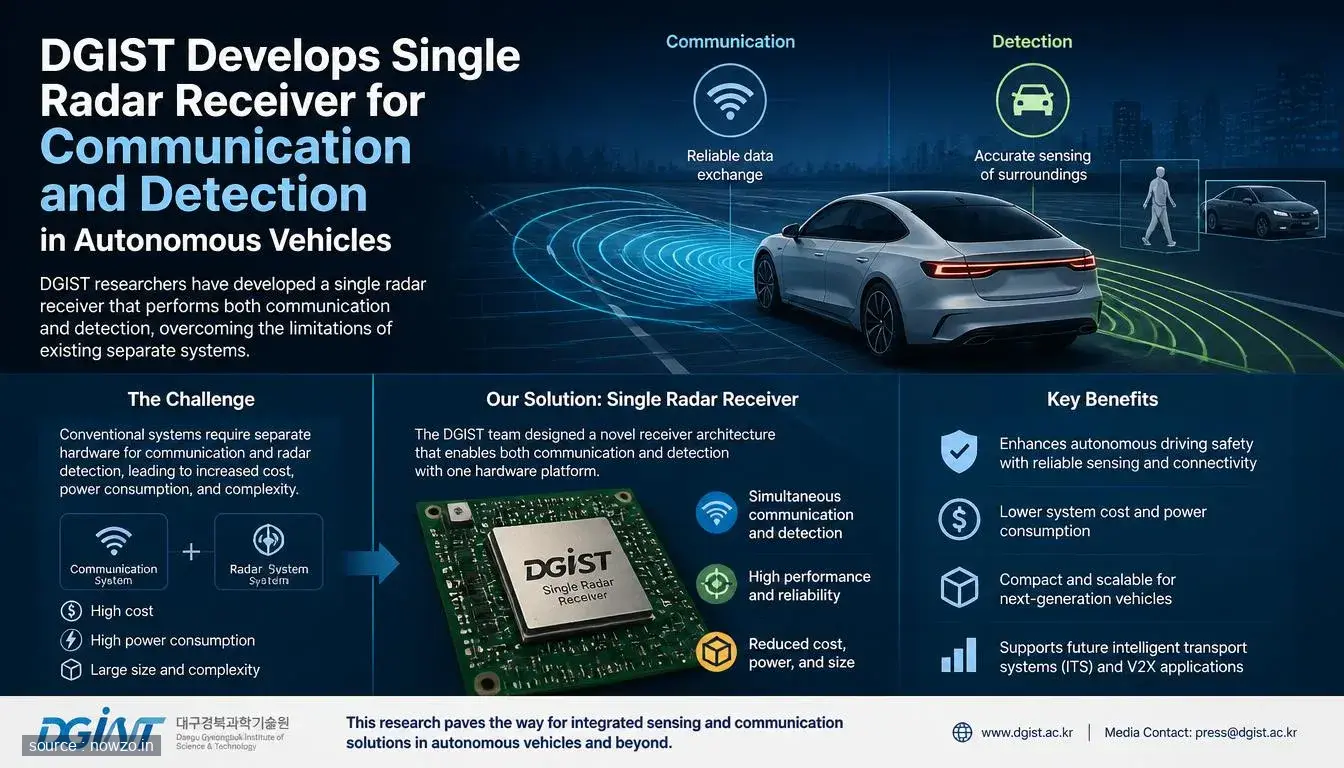
Researchers at the Daegu Gyeongbuk Institute of Science and Technology (DGIST) have developed a new receiver technology that allows a single radar system to handle both communication and detection functions, a breakthrough aimed at reducing the computational burden on autonomous vehicles.
One Radar, Two Functions
The newly developed receiver technology enables a single radar to perform dual roles, managing both communication and detection tasks simultaneously. According to the research team, the approach is designed around the concept of "a single radar to handle both communication and detection."
Reducing the Computational Load
Autonomous vehicles rely on a wide array of sensors and systems that demand significant processing power. By consolidating communication and detection into one radar receiver, the DGIST technology lightens the computational load on self-driving systems, potentially streamlining how these vehicles process critical information.
Looking Ahead
The development marks a step forward in radar and receiver design for autonomous driving applications. By simplifying hardware demands while maintaining dual functionality, the technology could support more efficient autonomous vehicle systems in the future.


Comments