
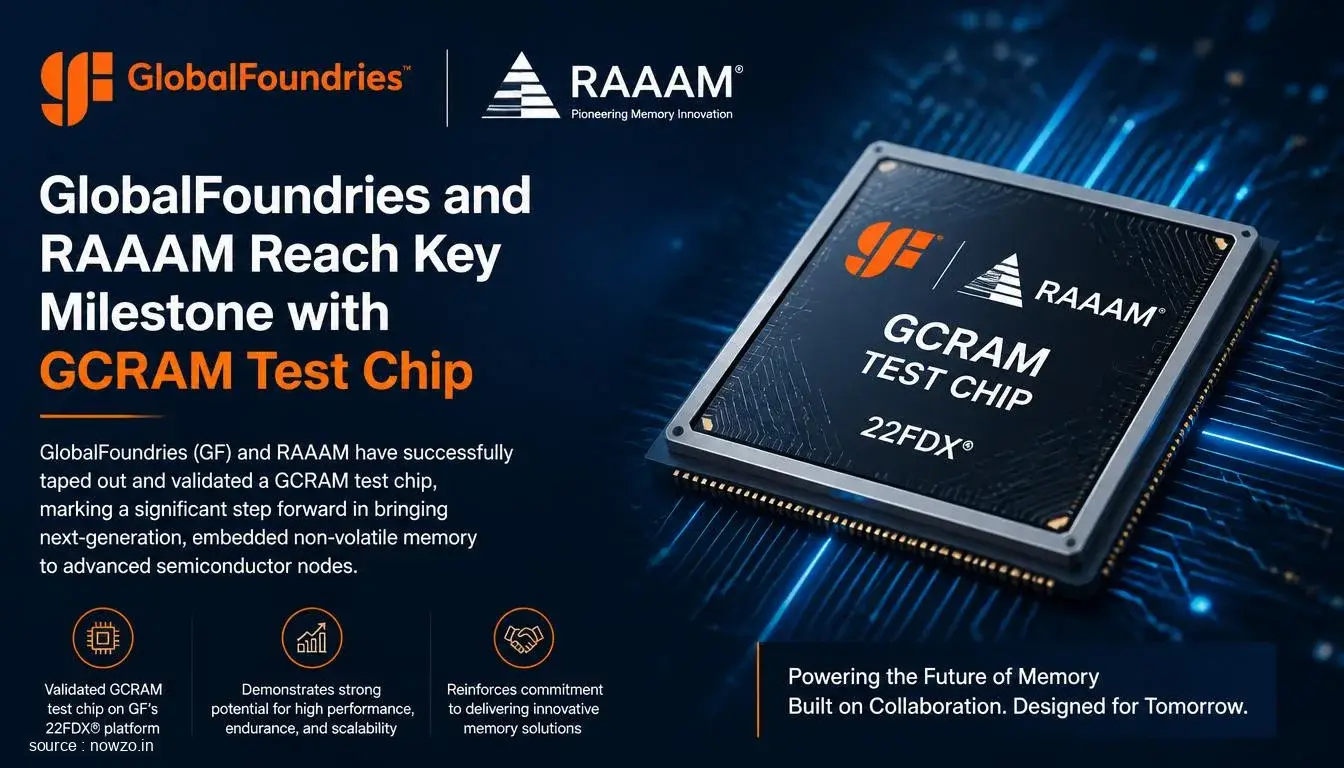
GlobalFoundries and semiconductor memory innovator RAAAM have hit an important milestone in the development of next-generation memory technology, advancing their Gain-Cell RAM (GCRAM) test chip through functional validation.
Key Facts
- Collaborators: Semiconductor foundry GlobalFoundries and memory specialist RAAAM.
- Core Focus: Next-generation Gain-Cell RAM (GCRAM) technology.
- Milestone: Progression and silicon validation of a dedicated GCRAM test chip.
Advancing Beyond Traditional On-Chip Memory
As modern computing workloads grow increasingly demanding, embedded memory architecture has become one of the industry's most stubborn performance bottlenecks. From edge computing nodes to high-efficiency processing units, system designers continually wrestle with the trade-offs between density, power dissipation, and silicon area.
RAAAM's GCRAM architecture aims to tackle these constraints directly by providing an alternative to standard on-chip memory options, striving for higher density and reduced power requirements. Reaching a test chip milestone marks an essential shift from simulation into real-world silicon feasibility.
The Value of the Test Chip Milestone
In semiconductor manufacturing, test chips are the ultimate proving ground. They allow foundries and design teams to gather essential empirical data regarding yield, electrical behavior, and reliability under true production parameters.
By validating this milestone on GlobalFoundries' manufacturing process, the partnership signals strong progress toward integrating GCRAM into broader commercial semiconductor roadmaps, opening the door to denser, more power-efficient system-on-chip (SoC) designs in the near future.





Comments