
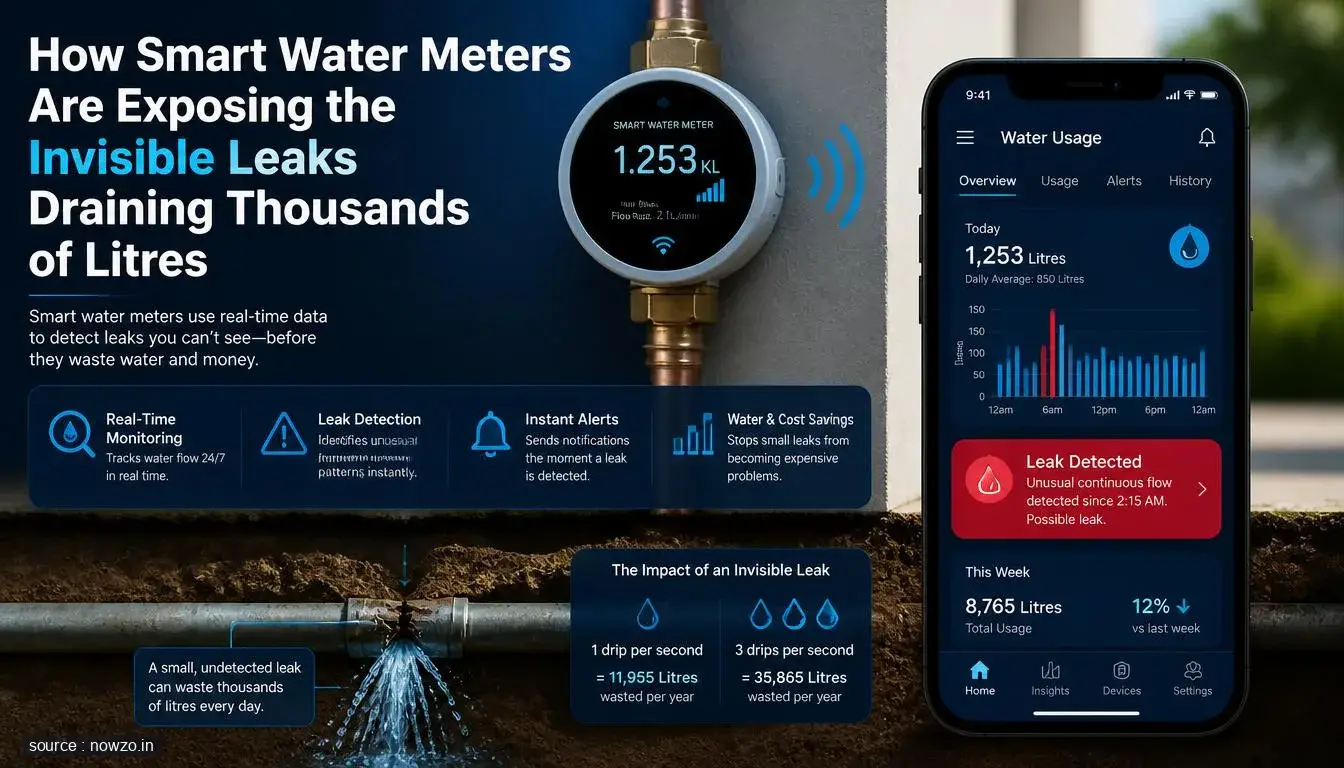
Water loss rarely announces itself with a dramatic burst pipe or a flooded basement. More often, it happens in absolute silence — a hairline fracture inside a wall cavity, an underground supply line seepage, or an uncalibrated valve running unnoticed behind drywall. Over weeks and months, these invisible breaches quietly siphon away thousands of litres of treated water, leaving property owners with inflated utility bills and communities with depleted reserves.
Key Highlights
- Silent, unseen leaks account for massive domestic and municipal water wastage over time.
- Digital smart water meters track continuous flow patterns rather than relying on periodic manual readings.
- Automated real-time anomaly detection flags micro-leaks long before visible dampness or structural damage occurs.
The Hidden Cost of Silent Leaks
Traditional utility meters are passive counters: a technician reads the dial once a month, recording aggregate consumption long after an undetected leak has already wasted vast quantities of water. In contrast, subterranean piping and concealed plumbing networks can harbor steady micro-drips that evade visual inspection entirely.
When a leak remains hidden, the damage compounds on two fronts. First is the ecological and financial cost of lost clean water. Second is the insidious risk to infrastructure, where persistent moisture gradually compromises masonry, fosters mold growth, and destabilizes foundations.
How Smart Metering Changes the Equation
Smart water meters transform how residential and commercial properties monitor fluid dynamics. Instead of mechanical dials, these connected devices utilize high-precision ultrasonic or electromagnetic sensors capable of measuring granular changes in flow rates.
By monitoring water usage continuously, smart systems identify abnormal baselines — such as an unbroken, slow trickle during midnight hours when all taps are closed — instantly signaling the presence of an active leak.
Predictive Defense for Modern Infrastructure
Beyond simple measurement, many next-generation smart metering ecosystems integrate cellular or low-power wireless communication to alert homeowners and facility managers directly via mobile dashboards. Catching an anomalous flow in its first hour prevents catastrophic structural decay and curtails needless resource loss.
As water scarcity intensifies globally, transitioning from reactive repair to continuous digital monitoring represents one of the most effective conservation upgrades available to modern buildings.


Comments