
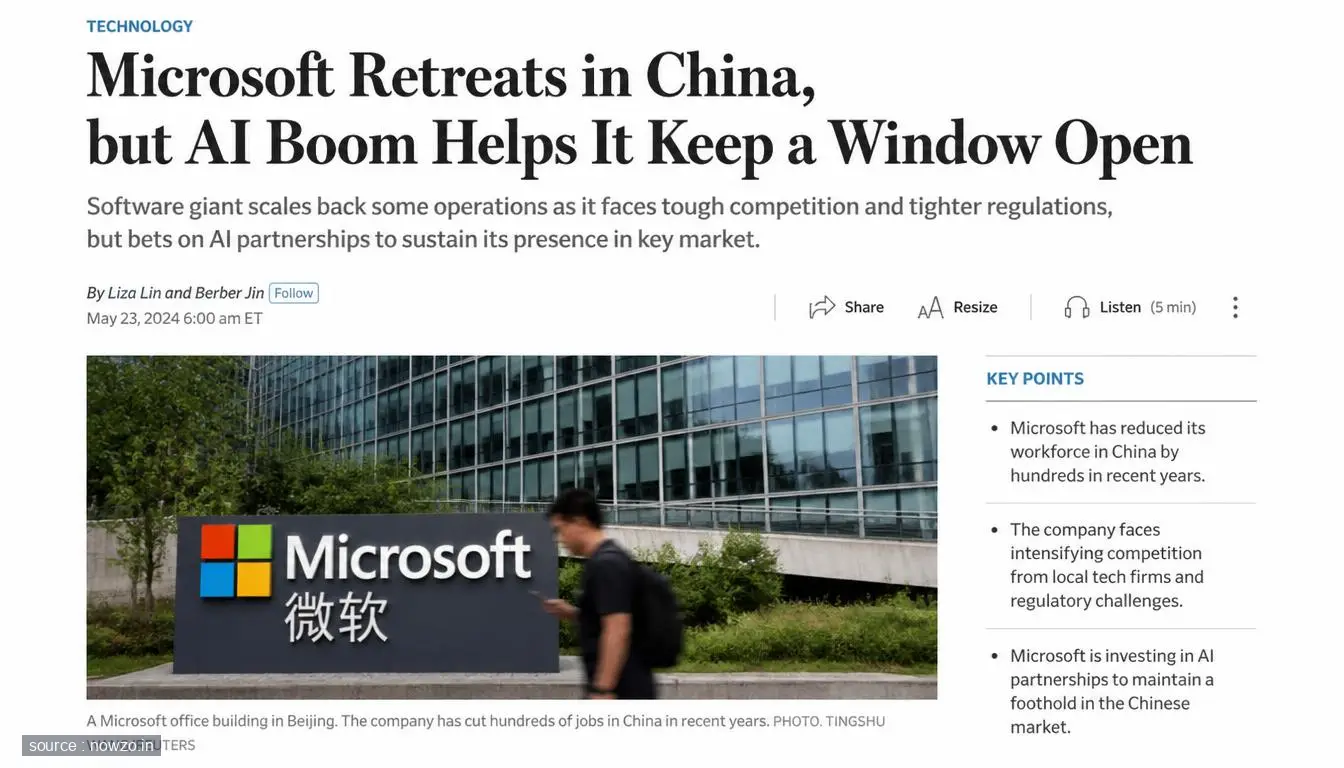
Microsoft is scaling back its operations in China, marking a notable shift for one of the world's most valuable technology companies as it navigates an increasingly complex geopolitical landscape. However, the global artificial intelligence boom is providing the Redmond-based giant with a compelling reason to maintain a presence in the country, even as other doors close.
A Strategic Pullback
Microsoft's retreat from China reflects broader challenges facing American technology firms operating in the region. Rising tensions between Washington and Beijing, coupled with tightening regulations on data, security, and foreign business operations, have made the Chinese market increasingly difficult for US tech companies to navigate.
The pullback is part of a wider trend among Western technology firms reassessing their exposure to China. Companies across the sector have been forced to weigh the enormous commercial potential of the Chinese market against growing political, regulatory, and reputational risks.
For Microsoft, which has maintained a presence in China for decades, the decision to scale back represents a significant recalibration of its global strategy. The company has long viewed China as an important market, but the operating environment has become progressively more challenging in recent years.
AI as a Lifeline
Despite the broader retreat, the artificial intelligence revolution is offering Microsoft a way to stay connected to the Chinese market. The global surge in demand for AI technologies, cloud computing infrastructure, and related services has created opportunities that transcend traditional market boundaries.
Microsoft has positioned itself as a leader in the AI space, largely through its partnership with OpenAI and the integration of AI capabilities across its product lineup, including Azure cloud services, Microsoft 365, and its Copilot assistant. This AI-driven momentum has become a critical growth engine for the company worldwide.
The AI boom has also created demand for computing power and cloud services that benefits companies like Microsoft, even in markets where their direct consumer-facing presence may be diminishing. Chinese companies and developers seeking access to cutting-edge AI tools and cloud infrastructure represent a potential avenue for continued engagement.
Navigating a Complex Landscape
The situation underscores the delicate balancing act that multinational technology companies must perform in today's fragmented global economy. On one hand, there is immense pressure to decouple from China amid national security concerns and regulatory scrutiny. On the other, the sheer scale of the Chinese market and its role in the global technology ecosystem make a complete withdrawal costly and complicated.
Microsoft's approach appears to be one of selective engagement — pulling back in areas where risks are highest while maintaining channels that allow it to benefit from China's role in the global AI and technology landscape.
The company's experience mirrors that of other tech giants grappling with similar dilemmas. As AI continues to reshape the global technology industry, the interplay between geopolitical realities and commercial opportunities will remain a defining challenge for companies operating across borders.
Looking Ahead
Microsoft's evolving strategy in China highlights how the AI boom is reshaping not just products and services, but also the geopolitical calculus of the world's largest technology companies. While the company's footprint in China may be shrinking, the transformative power of artificial intelligence ensures that the relationship — however constrained — is far from over.
As both the AI race and US-China tensions continue to evolve, Microsoft's ability to adapt its approach will be closely watched by investors, policymakers, and industry observers alike.


Comments