
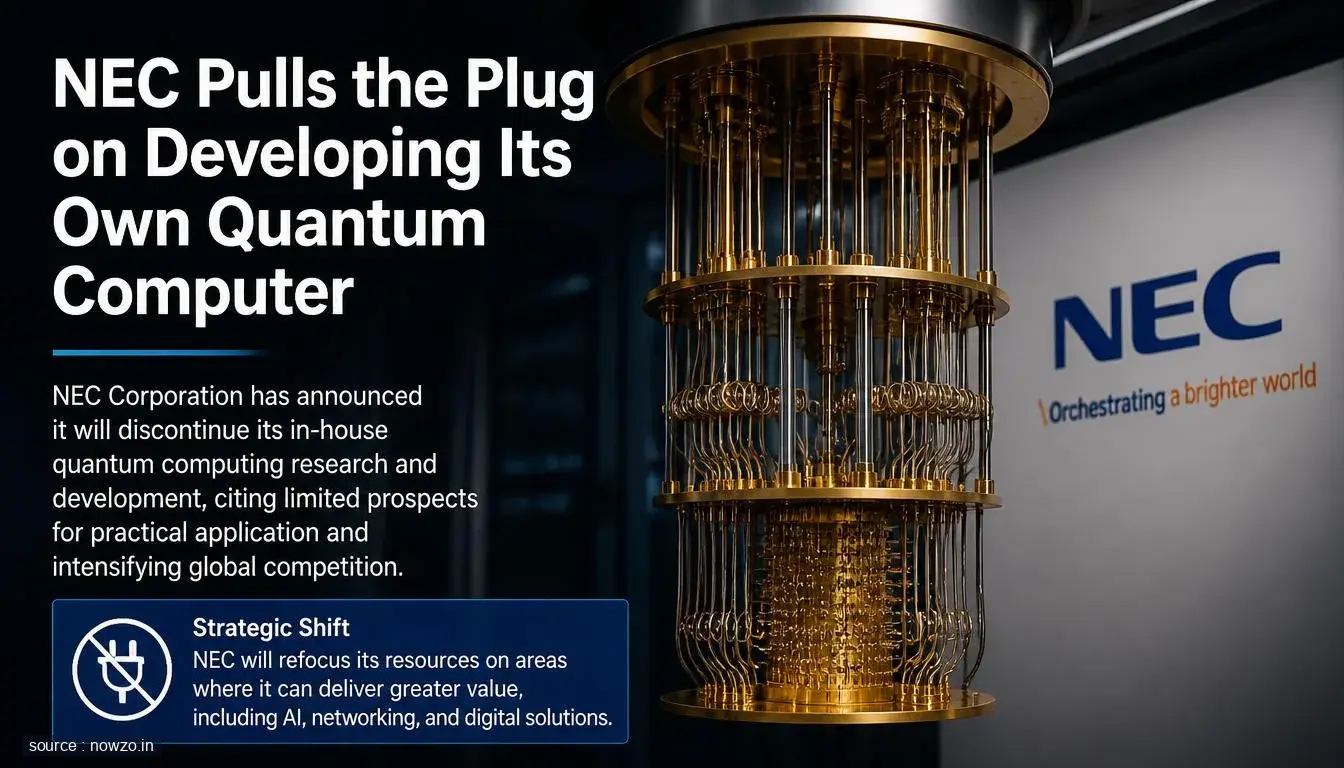
In a striking departure from the high-stakes global race to construct functional quantum hardware, Japanese technology heavyweight NEC has decided to abandon its initiative to build a quantum computer, according to a report from Nikkei Asia.
Key Facts
- Japanese electronics titan NEC has scrapped plans to build its own quantum computer.
- The strategic retreat was reported by business publication Nikkei Asia.
- The decision underscores the immense hurdles of commercializing proprietary quantum hardware.
A Notable Retreat from Quantum Hardware
Developing operational quantum machinery has emerged as one of the most grueling scientific frontiers of the century. It requires deep institutional pockets, decades of patience, and specialized engineering to keep fragile quantum bits stable. NEC's choice to halt its machine-building ambitions reflects the stiff headwinds facing legacy tech firms trying to construct full-stack quantum architectures from the ground up.
Refocusing Amid Fierce Global Competition
The race to unlock commercial quantum computing has seen global rivals pour billions into competing qubit architectures, ranging from superconducting circuits to trapped ions and photonics. For corporate giants like NEC, deciding whether to continue burning capital on proprietary hardware or reallocate resources toward enterprise software, security, and algorithmic deployment is becoming an existential calculation.
Building physical quantum computers remains a brutal capital and engineering gamble. Nikkei Asia's reporting signals that even seasoned technology manufacturers are reassessing whether the long-term payoff justifies the mounting cost of domestic hardware fabrication.
The Road Ahead
While the hardware program is being stood down, the move does not necessarily shut NEC out of the broader quantum ecosystem. Across the international tech sector, several organizations that have stepped back from physical fabrication have redirected their expertise toward quantum applications, quantum-inspired algorithms, and high-performance computing hybrids designed to serve enterprise clients right now.




Comments