
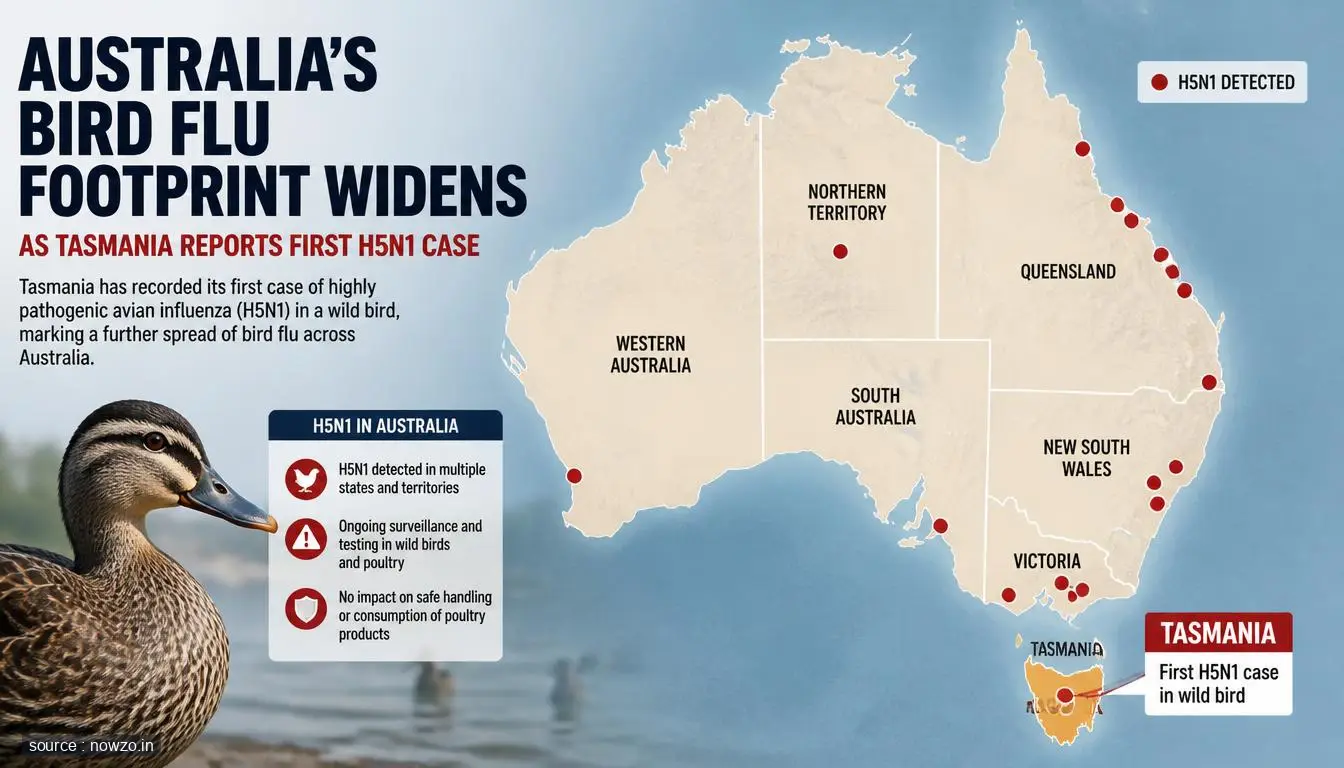
Australia's battle against avian influenza has entered a new phase, with Tasmania confirming its first case of the H5N1 strain — a development that extends the virus's reach across the country and signals a shift in how authorities plan to communicate future detections.
The island state's first positive detection of the H5 bird flu virus was confirmed in a bird, making Tasmania the latest Australian jurisdiction to report the presence of the highly pathogenic avian influenza strain. Until now, Tasmania had remained free of the H5N1 virus even as other parts of the country grappled with outbreaks.
Tasmania Records Its First H5 Positive Bird
The detection in Tasmania represents a notable widening of the virus's footprint across Australia. The confirmation of an H5 positive bird in the state ends its status as one of the remaining jurisdictions without a recorded case of the strain.
Authorities have been closely monitoring the spread of avian influenza, and the Tasmanian detection underscores the challenges of containing a virus that can be carried by wild birds across vast distances. The case adds to growing national concern about the reach of H5N1 and its potential impact on both wildlife and the poultry industry.
Federal Government Changes Reporting Approach
In a significant policy shift, the federal government has announced it will no longer report individual detections of bird flu. The change in reporting strategy comes as the virus becomes more widespread, altering how the public and industry will receive updates on new cases going forward.
The decision marks a departure from the earlier approach of publicly detailing each new detection. Under the revised framework, the focus shifts away from case-by-case announcements, reflecting the evolving nature of the outbreak response across the country.
Victoria's Poultry Farms Ordered to Lock Down
Meanwhile, in Victoria, poultry farms have been ordered to lock down after bird flu was detected. The measure is aimed at curbing the spread of the virus within the state's poultry industry, which has been on high alert as avian influenza continues to circulate.
The lockdown orders reflect the seriousness with which authorities are treating detections in commercial poultry settings, where the virus can spread rapidly and have devastating consequences for flocks and producers alike.
Little Penguins to Receive H5 Vaccine
In a proactive step to protect vulnerable wildlife, little penguins are set to receive the H5 vaccine. The move highlights growing concern about the impact of avian influenza on Australia's native bird species, particularly those considered at risk from the virus.
The vaccination effort for little penguins represents a broader strategy to safeguard wildlife populations as the H5N1 strain continues to spread. Conservationists and health authorities alike have been watching the virus's progression closely, given its potential to affect a wide range of bird species.
A National Challenge Evolving
Taken together, the developments paint a picture of a nation adapting to a shifting avian influenza landscape. From Tasmania's first detection to Victoria's farm lockdowns, from changes in federal reporting to wildlife vaccination programs, Australia's response to bird flu is evolving on multiple fronts.
The widening footprint of H5N1 across Australia serves as a reminder of the virus's persistence and the ongoing need for vigilance. As authorities adjust their strategies — both in containment and communication — the coming weeks and months will be critical in determining how effectively the country can manage the spread of the virus among both wild and domestic bird populations.
For now, the confirmation of Tasmania's first case stands as a milestone in the outbreak — one that brings the reach of H5N1 into sharper national focus and reinforces the importance of coordinated action across states, industries, and conservation efforts.




Comments