
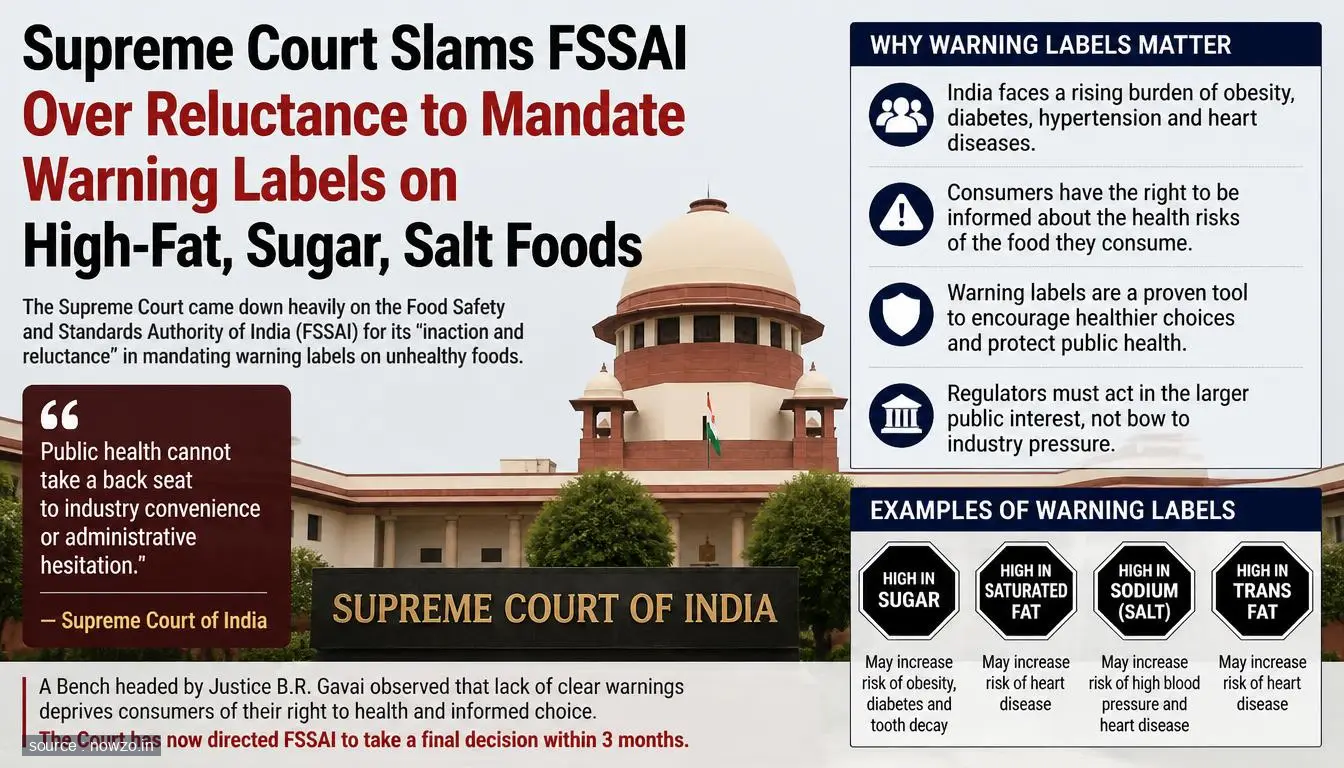
The Supreme Court of India has delivered a sharp rebuke to the Food Safety and Standards Authority of India (FSSAI) over its continued reluctance to mandate warning labels on packaged foods high in sugar, salt, and fat. The apex court questioned whether the food regulator was bowing to corporate pressure and issued a stern ultimatum to the Centre, signaling its growing impatience with the prolonged delay in implementing front-of-pack labeling norms.
Supreme Court Questions FSSAI's Intentions
During the hearing, the Supreme Court did not mince words as it grilled FSSAI over its opposition to warning labels on food products. The court asked pointedly whether the regulator's reluctance stemmed from corporate pressure, a question that underscores the seriousness with which the judiciary views the matter of public health.
The bench expressed frustration over FSSAI's continued resistance to implementing front-of-pack warning labels, which are designed to alert consumers about high levels of sugar, salt, and fat in packaged food products. The court's sharp questioning reflected its concern that the food regulator may be prioritizing industry interests over the health of millions of Indian consumers.
"If You Can't, We Will": Court's Ultimatum to Centre
In a clear message to the government, the Supreme Court issued an ultimatum, effectively telling the Centre that if authorities fail to act on food labeling, the court itself will step in. This strong stance highlights the judiciary's willingness to intervene directly in matters of public health when regulatory bodies fail to discharge their duties.
The court asked the authorities directly whether they did not want people to be healthy, a pointed remark that captures the frustration felt by many public health advocates who have long pushed for stricter food labeling regulations in India. The question also reflects the broader concern that regulatory inaction on food labeling could have serious consequences for public health, particularly as lifestyle diseases linked to poor dietary habits continue to rise across the country.
FSSAI Proposes Nutritional Tables Instead of Warning Labels
Instead of implementing warning labels, FSSAI has proposed the use of nutritional tables on food packs. This alternative approach has been met with skepticism by the court and public health experts alike, who argue that nutritional tables are less effective in communicating health risks to consumers compared to clear, prominent warning labels.
Front-of-pack warning labels are considered a more effective tool for informing consumers about the nutritional quality of food products, particularly in a country like India where literacy levels vary widely. Warning labels provide a simple, visual cue that can be understood by all consumers, regardless of their educational background or nutritional knowledge.
The debate over food labeling in India has been ongoing for several years, with public health advocates pushing for mandatory warning labels while the food industry has resisted such measures. The Supreme Court's intervention marks a significant moment in this debate, as it puts direct pressure on both the regulator and the government to prioritize public health over industry interests.
Broader Implications for Public Health in India
The Supreme Court's strong stance on food labeling comes at a time when India is grappling with a growing burden of non-communicable diseases, including diabetes, obesity, and cardiovascular conditions. Many of these health issues are directly linked to the consumption of foods high in sugar, salt, and fat, making effective food labeling a critical public health intervention.
The court's criticism of FSSAI also raises important questions about the independence of regulatory bodies in India and the influence of corporate interests on public policy. By directly asking whether corporate pressure was behind FSSAI's reluctance, the Supreme Court has brought this issue into the open, demanding accountability from the food regulator.
As the matter continues to unfold, all eyes will be on FSSAI and the Centre to see how they respond to the court's ultimatum. The outcome of this case could have far-reaching implications for food labeling regulations in India and could set a precedent for how regulatory bodies balance industry interests with public health imperatives.





Comments