
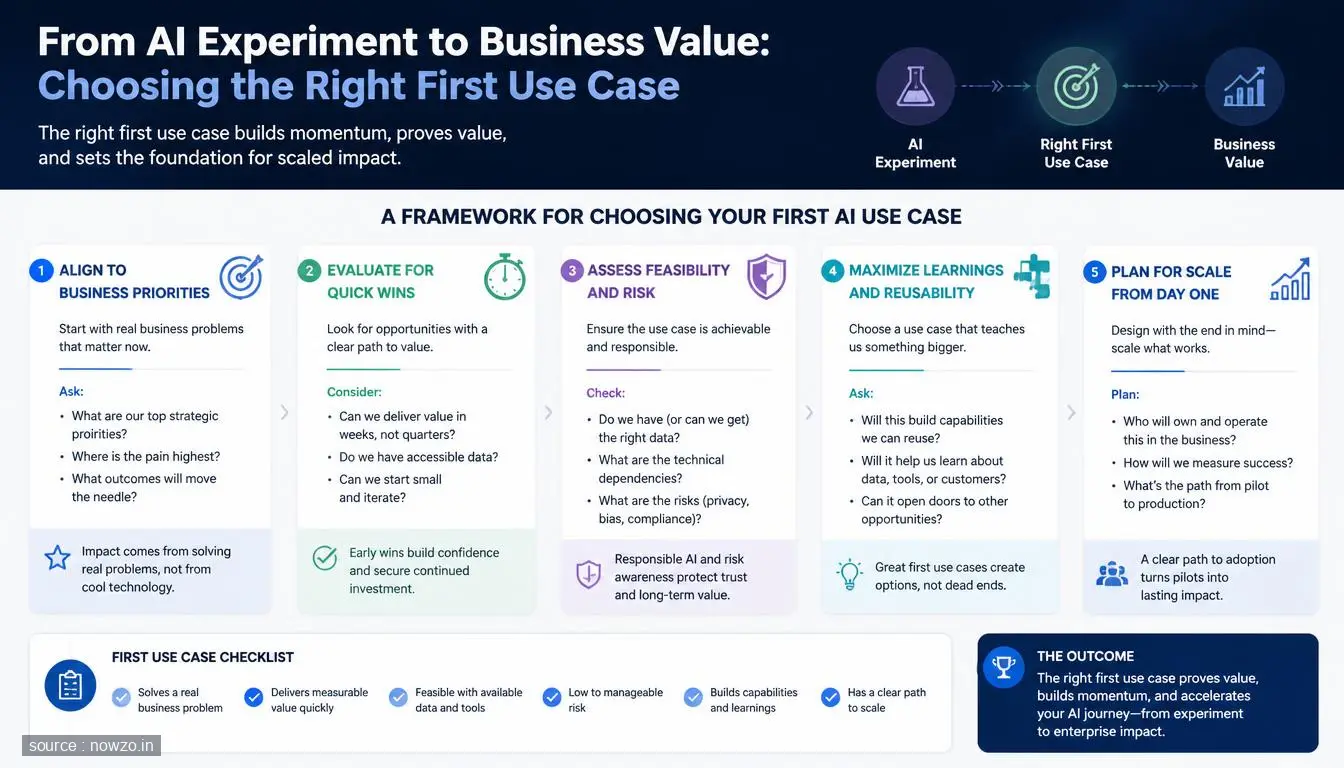
Organizations today face a critical challenge: moving beyond artificial intelligence experiments to generate real business value. The journey from AI experimentation to practical implementation requires careful planning and strategic decision-making.
The Challenge of AI Implementation
Many companies find themselves stuck in the experimentation phase, unable to translate their AI initiatives into measurable business outcomes. This gap between proof-of-concept and production-ready solutions represents one of the most significant hurdles in enterprise AI adoption.
The key to success lies not in the technology itself, but in selecting the appropriate first use case that aligns with business objectives and organizational capabilities.
Choosing Your First AI Use Case
Selecting the right initial AI application can determine the success or failure of your entire AI strategy. The ideal first use case should balance ambition with practicality, offering clear value while remaining achievable within existing constraints.
Organizations must evaluate potential use cases against multiple criteria, including data availability, technical feasibility, business impact, and organizational readiness. This comprehensive assessment helps identify opportunities that can deliver quick wins while building momentum for broader AI adoption.
From Experiment to Value
The transition from experimental AI projects to value-generating business solutions requires a structured approach. Companies must establish clear success metrics, secure stakeholder buy-in, and ensure adequate resources for implementation and scaling.
Success in this phase often depends on starting with well-defined problems that have measurable outcomes. This focus allows organizations to demonstrate concrete value, build internal confidence, and create a foundation for more ambitious AI initiatives.
Building a Sustainable AI Strategy
Moving from AI experiments to business value is not a one-time effort but an ongoing process. Organizations must develop capabilities for continuous learning, adaptation, and improvement as they expand their AI portfolio.
By carefully selecting the right first use case and maintaining focus on business outcomes, companies can transform AI from an experimental technology into a driver of sustainable competitive advantage.


Comments