
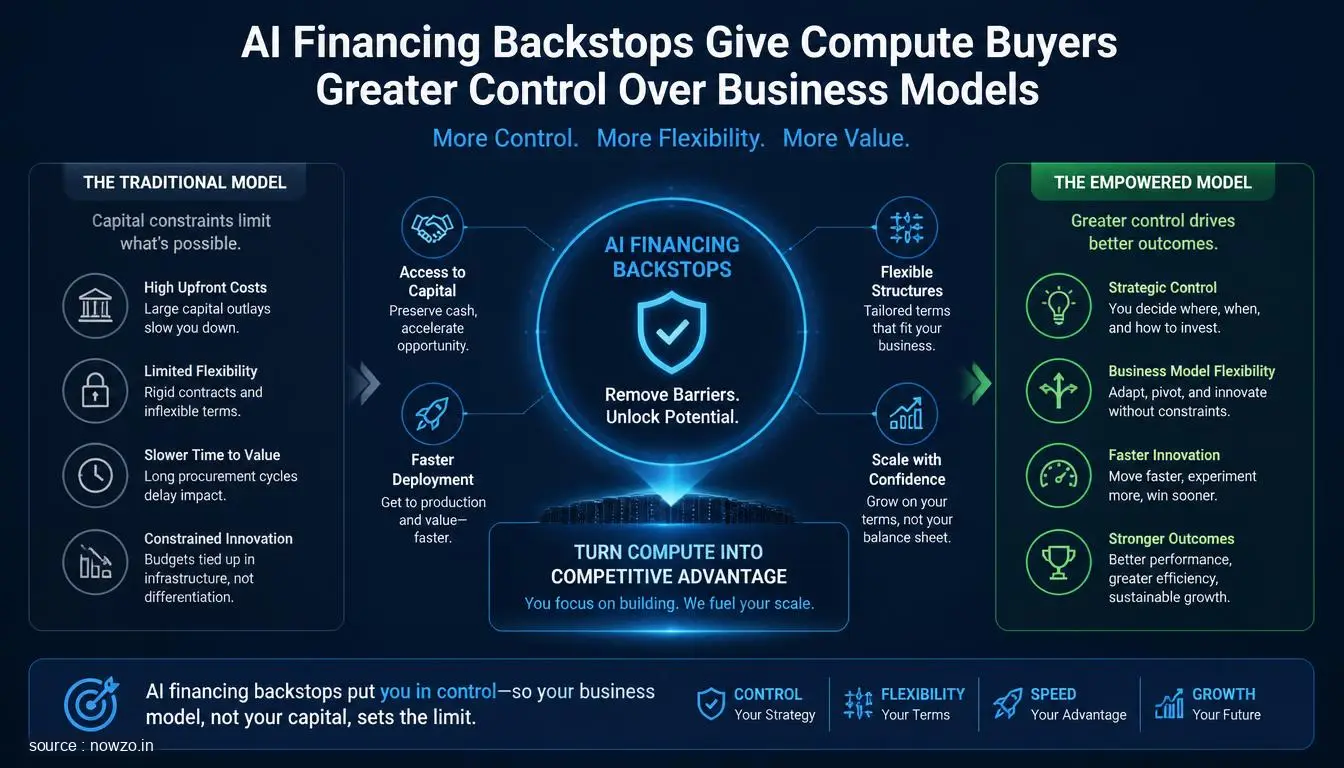
The rapid expansion of artificial intelligence infrastructure is prompting new financial structures designed to help compute buyers manage risk and maintain control over their business models. According to recent reporting, new AI financing backstops are emerging as a mechanism that gives companies purchasing computing power greater flexibility in how they structure and fund their operations.
What Are AI Financing Backstops?
As demand for AI compute continues to surge, the cost of securing the necessary hardware and infrastructure has become a significant challenge for many companies. Financing backstops are arrangements that provide a safety net for buyers of computing capacity, helping them manage the substantial capital commitments involved in AI infrastructure deals.
These backstops allow compute buyers to pursue ambitious AI strategies without bearing the full weight of financial risk on their own balance sheets. By providing a layer of financial security, these arrangements enable companies to commit to large-scale compute purchases while retaining more control over how their business models evolve.
Growing Demand for Compute Power
The AI boom has driven unprecedented demand for computing resources, particularly the advanced chips and data center capacity needed to train and run large language models and other AI systems. This demand has created a market where compute buyers often need to make significant upfront commitments to secure the resources they need.
Financing backstops address a key tension in this market: companies want access to large amounts of compute power, but the costs and risks involved can be prohibitive. By introducing financial structures that share or offset some of that risk, backstops make it easier for a wider range of companies to participate in the AI economy.
Implications for the AI Industry
The emergence of these financing mechanisms reflects the maturing of the AI infrastructure market. As the industry moves beyond its earliest stages, financial innovation is becoming just as important as technological innovation in determining which companies can compete effectively.
For compute buyers, the availability of backstops means more options when structuring deals. Rather than being locked into rigid purchasing agreements, companies can negotiate terms that better align with their business strategies and risk tolerance. This flexibility could prove especially valuable as the AI market continues to evolve rapidly.
The trend also highlights the growing role of financial engineering in the technology sector. As AI infrastructure spending reaches into the hundreds of billions of dollars, the structures used to finance that spending are becoming increasingly sophisticated.
Looking Ahead
As AI continues to drive demand for computing power, financing innovations like backstops are likely to become more common. Companies that can effectively leverage these tools may find themselves better positioned to scale their AI operations while managing financial risk.
The development underscores a broader shift in the AI industry, where access to capital and financial structuring are becoming key competitive advantages alongside technical capabilities. For compute buyers, the message is clear: new financing tools are providing more ways to control their destiny in an increasingly competitive market.






Comments