
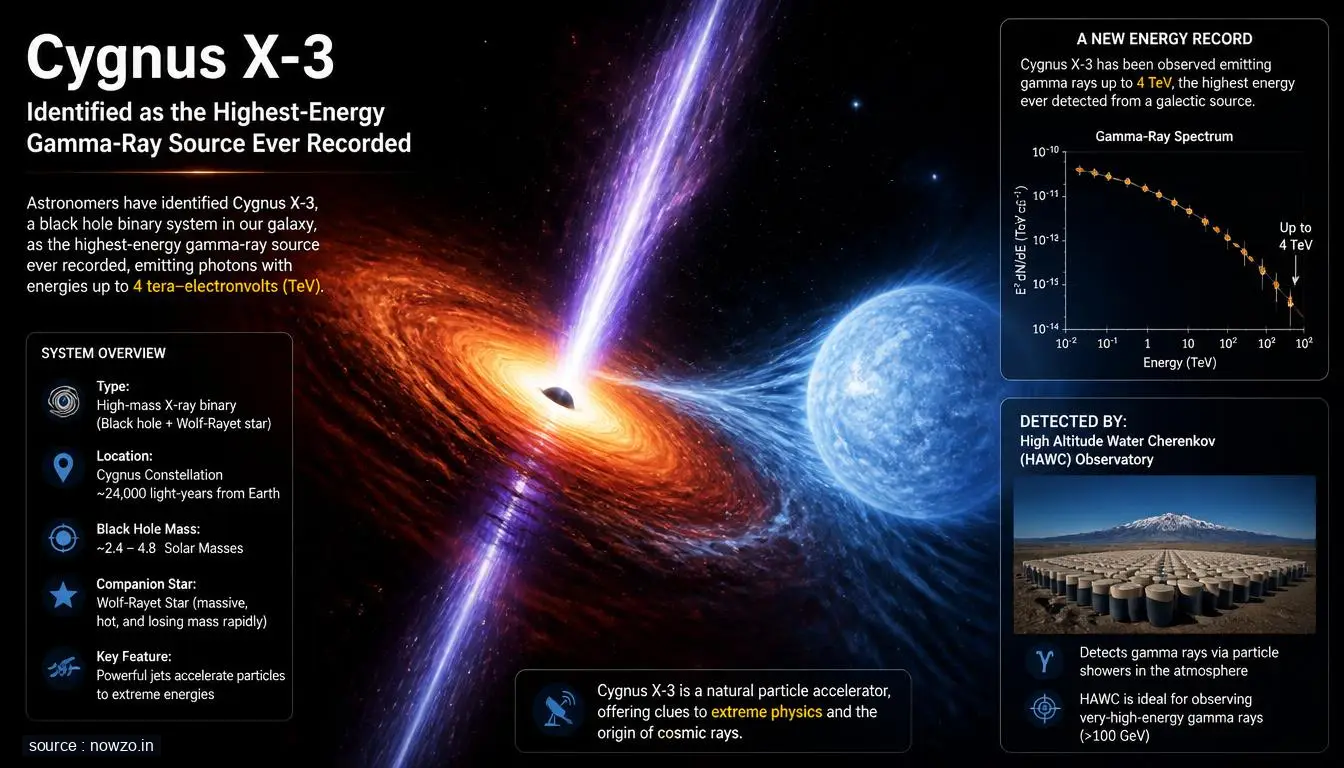
Astronomers have identified Cygnus X-3 as the highest-energy gamma-ray source known to science, marking a significant milestone in high-energy astrophysics. The detection, made using the Large High Altitude Air Shower Observatory (LHAASO), establishes the object as the first variable source of PeV gamma rays ever observed.
LHAASO Identifies First Variable PeV Gamma-ray Source
The Chinese Academy of Sciences (CAS) confirmed that LHAASO has identified the first variable PeV gamma-ray source. This detection represents a breakthrough in the study of ultra-high-energy cosmic phenomena, as PeV gamma rays are among the most energetic photons observed in the universe.
The identification of Cygnus X-3 as this record-setting source provides researchers with a new laboratory for studying particle acceleration processes under extreme conditions.
Microquasar Link to Mysterious Cygnus Bubble
Astronomers suggest that the mysterious Cygnus Bubble may trace back to a microquasar. Cygnus X-3 is classified as a microquasar, a compact object that launches powerful jets of matter and radiation.
The connection between the microquasar and the Cygnus Bubble could explain the origin of this enigmatic structure. Researchers speculate that the high-energy emissions from Cygnus X-3 are responsible for inflating or energizing the bubble.
Implications for High-Energy Astrophysics
The discovery positions Cygnus X-3 as a unique natural laboratory for studying the most violent processes in the universe. As the highest-energy gamma-ray source known, it offers unprecedented insights into how particles are accelerated to extreme energies.
Future observations of this variable PeV source will help astronomers better understand the mechanisms behind the universe's most energetic phenomena and the role microquasars play in shaping their surroundings.




Comments