
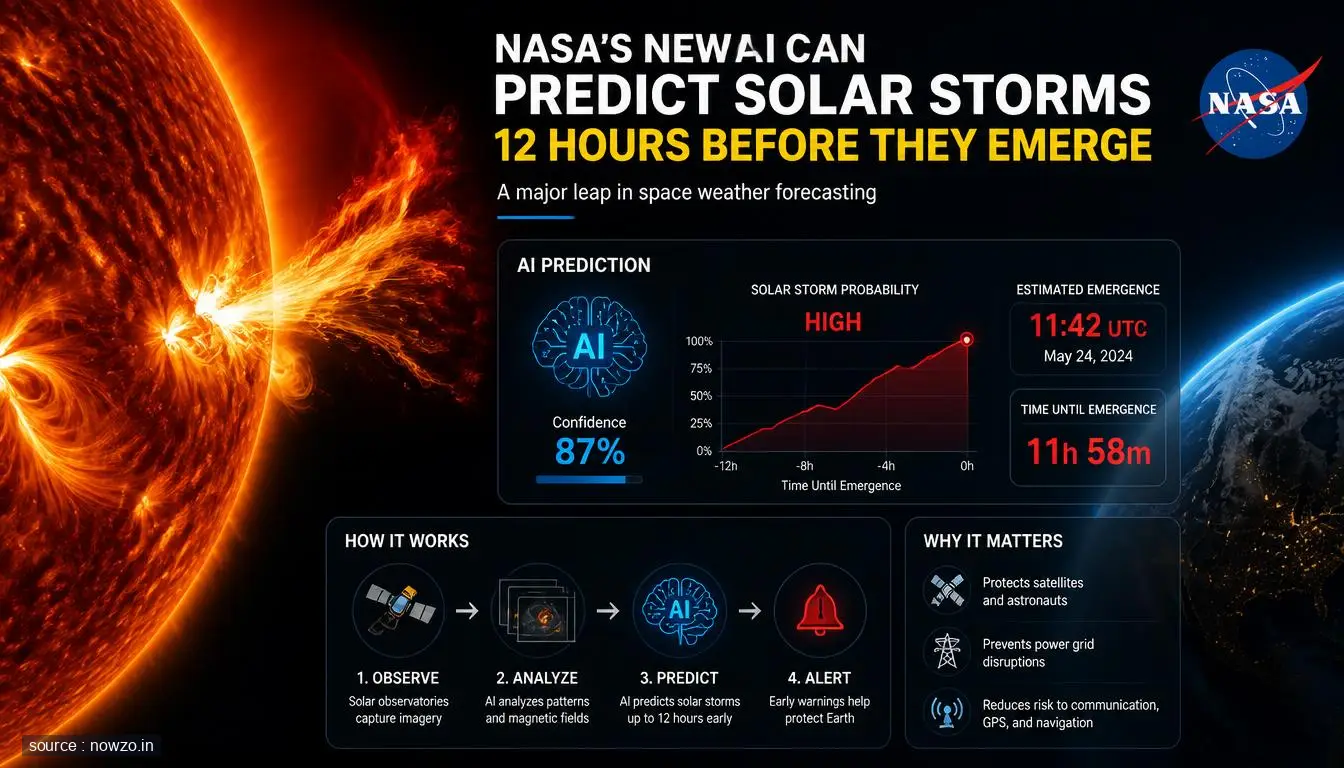
NASA has developed a new artificial intelligence system that can predict solar storms up to 12 hours before they appear on the Sun's surface. The breakthrough technology, called COFFIES, represents a significant advancement in space weather forecasting and could help protect critical infrastructure on Earth and in orbit.
The AI model works by detecting hidden signs of solar eruptions hours before they emerge, giving scientists and engineers valuable lead time to prepare for potentially disruptive space weather events. Solar storms, which include coronal mass ejections (CMEs), can have serious consequences for satellite communications, power grids, and navigation systems.
How COFFIES Works
COFFIES uses artificial intelligence to identify storm-causing active regions on the Sun before they become visible through conventional observation methods. By analyzing subtle indicators and patterns in solar activity, the system can flag areas where magnetic energy is building up and predict where eruptions are likely to occur.
The computer model can help trace how magnetic energy builds up on the Sun and forecast the impact of resulting coronal mass ejections. This capability is crucial because CMEs — massive bursts of solar wind and magnetic fields rising above the solar corona — are among the most dangerous forms of space weather.
When these eruptions are directed toward Earth, they can trigger geomagnetic storms that disrupt satellite operations, degrade GPS accuracy, interfere with radio communications, and in severe cases, damage power grid infrastructure on the ground.
Improving Space Weather Forecasts
Beyond its ability to predict solar storms before they appear, COFFIES is also expected to help improve overall space weather forecasts. Current forecasting methods often provide limited advance warning, making it difficult for operators of satellites, power systems, and other vulnerable technology to take protective action.
With a 12-hour prediction window, the new AI system offers a meaningful improvement in early warning capabilities. This additional time could allow satellite operators to place spacecraft in safe modes, power grid managers to take precautionary measures, and airlines to reroute flights that pass over polar regions where radiation exposure from solar storms is highest.
Why Solar Storm Prediction Matters
Space weather events driven by solar activity pose a growing threat as modern society becomes increasingly dependent on technology that is vulnerable to electromagnetic disruption. Satellites that support communications, navigation, weather monitoring, and financial transactions are all at risk during severe solar storms.
The development of COFFIES comes at a time when the Sun is in an active phase of its natural cycle, making accurate and timely solar storm prediction more important than ever. Scientists have long sought better tools for anticipating these events, and the application of artificial intelligence to solar observation data represents a promising new approach.
By leveraging machine learning to detect patterns that might be invisible to human analysts or traditional forecasting models, NASA's AI system could fill critical gaps in the current space weather monitoring infrastructure.
Looking Ahead
The development of COFFIES marks an important step forward in the field of heliophysics and space weather prediction. As the system is refined and integrated into operational forecasting frameworks, it could become an essential tool for protecting both space-based and ground-based technology from the effects of solar storms.
NASA's investment in AI-driven space weather prediction reflects a broader recognition of the risks posed by solar activity and the need for more sophisticated early warning systems. With COFFIES, the agency is positioning itself at the forefront of efforts to understand and mitigate the impact of the Sun's most powerful eruptions.




Comments