
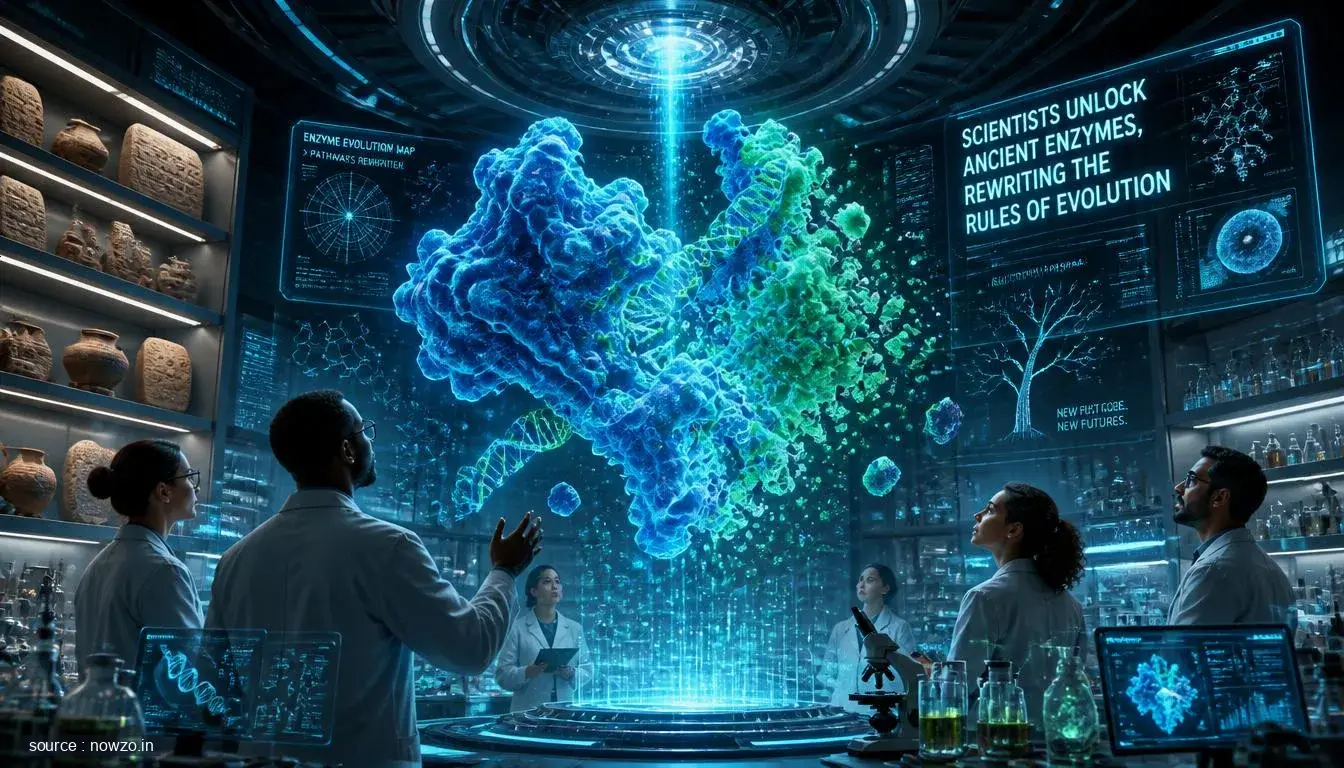
Imagine peering back through 2.5 billion years of evolutionary history to witness the molecular machinery that powered Earth's earliest life forms. That's precisely what a team of scientists has achieved through a revolutionary computational model that reconstructs ancient enzymes with stunning accuracy.
Key facts
- New computational model predicts structures of ancient enzymes
- Capable of reconstructing enzymes from 2.5 billion years ago
- Provides unprecedented insights into early evolutionary biology
- Reveals functional capabilities of primordial molecular machinery
Breaking the Time Barrier
For decades, scientists have struggled to understand how early enzymes functioned. The fossil record preserves bones and shells, but molecular structures vanish over geological time. This new model changes everything—it doesn't just guess at ancient biology; it calculates precise structural predictions that researchers can test and verify.
The Implications for Evolutionary Science
This breakthrough isn't just technical wizardry—it's rewriting our understanding of life's earliest days. By revealing how ancient enzymes worked, scientists can now trace the evolutionary pathways that led to modern metabolic processes. It's like finding the original blueprints for life's most fundamental machinery.
A New Window into Primordial Earth
The model's ability to reach back 2.5 billion years places us squarely in the Archean eon, when Earth's atmosphere was vastly different and life was finding its footing. Understanding these ancient enzymes helps explain how early organisms survived, thrived, and eventually transformed the planet through processes like photosynthesis and nitrogen fixation.



Comments